
Blog
Replacement Cost vs Fair Market Value for Insuring Your NYC Apartment Contents
Replacement cost and fair market value answer two different insurance questions: what it costs to buy a comparable item today, and what an item would actually sell for. This guide explains which standard governs your NYC co-op or rental policy, and when scheduling jewelry, art, or furniture calls for one measure over the other.
Ask a jewelry appraiser what your engagement ring is worth, then ask your insurance adjuster what it costs to replace it. You may get two very different numbers, and the gap between them sits at the center of nearly every scheduled personal property claim filed in New York City co-ops and rental apartments. Fair market value and replacement cost measure different things entirely, and putting the wrong one on your policy or your appraisal can leave you thousands of dollars short after a fire, theft, or flood. This guide breaks down how each standard is calculated, when your policy uses which one, and how often NYC's fast-moving art and luxury markets require you to refresh your numbers.
What Fair Market Value Measures: What Your Item Would Sell For
Fair market value answers a single question: what would this item actually sell for, between a willing buyer and a willing seller, neither one under pressure to act? Appraisers establish it using the sales comparison approach: completed auction results, closed retail sales, and documented resale transactions for property of similar age, condition, and quality. It is a backward-looking measure built from what has actually changed hands, not from what a retailer is currently asking.
In the insurance context, New York guidance treats standard apartment contents coverage as actual cash value (ACV) unless a policy endorsement changes that, and ACV is generally calculated as current replacement cost minus depreciation, not as a straight fair market value figure. Fair market value can still matter, though, particularly for antiques, designer pieces, and fine art where an active resale market exists and comparable sales data is the most credible evidence of worth. New York's Department of Financial Services notes that without receipts or documentation, insurers commonly default to this depreciated approach when settling a contents claim.
What Replacement Cost Measures: What It Costs to Buy a Comparable Item Today
Replacement cost value answers a different question: what would it cost, right now, to buy or reproduce an item of like kind and quality? Appraisers estimate this using current asking prices in the marketplace where the policyholder actually shops. That detail matters more than it sounds. If a client typically buys silver flatware or fine furniture from a high-end retailer or through an interior designer, the replacement cost figure should reflect that channel, not a discount outlet the client has never used. The National Association of Insurance Commissioners describes replacement-cost coverage as payment to repair or replace damaged property with materials of like kind and quality, without a deduction for depreciation.
For items still being manufactured or widely available, replacement cost is straightforward: find the current price of an equivalent new item. For pieces that are discontinued, custom-made, or one-of-a-kind, appraisers reproduce the value using the closest available substitute or, for genuinely irreplaceable property, an agreed or stated value negotiated between the client and the insurer. Our team of NYC personal property appraisers builds this distinction into every jewelry, art, and furnishings appraisal we prepare for insurance scheduling, because the wrong retail benchmark produces a number that will not hold up if a claim is challenged.
Fair Market Value vs Replacement Cost at a Glance
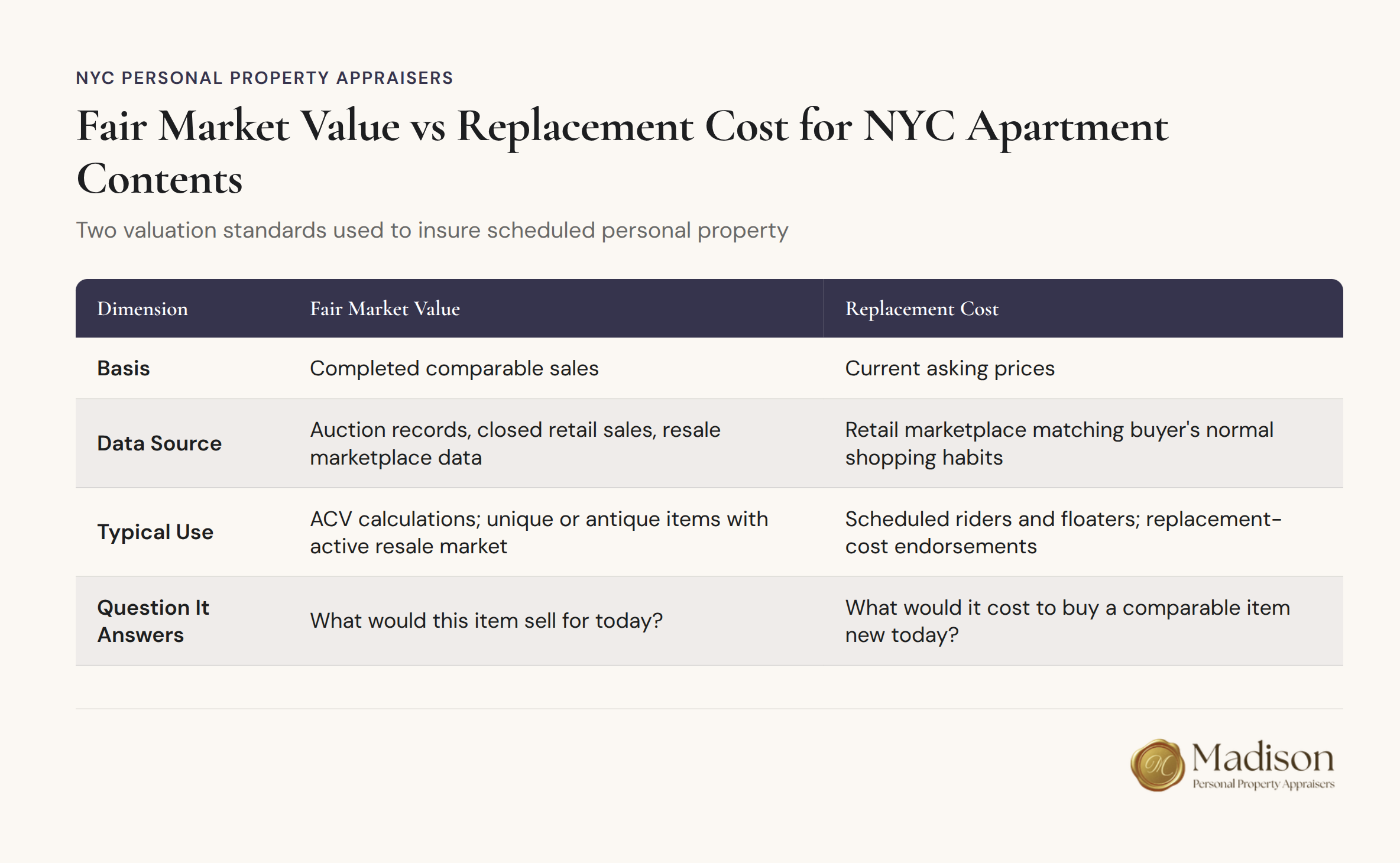
The two standards rely on different evidence, answer different questions, and get used for different purposes on an NYC policy. The table below lays out the core distinction appraisers and insurers apply to scheduled personal property.
| Standard | Basis | Data Source | Typical Use | Question It Answers |
|---|---|---|---|---|
| Fair Market Value | Completed comparable sales | Auction records, closed retail sales, resale marketplace data | ACV calculations; unique or antique items with an active resale market | What would this item sell for today? |
| Replacement Cost | Current asking prices | Retail marketplace matching the buyer's normal shopping habits | Scheduled riders and floaters; replacement-cost endorsements | What would it cost to buy a comparable item new today? |
Which Standard Applies to Your Co-op or Rental Policy?
Most standard HO-4 renters' and HO-6 co-op policies default to actual cash value for contents, meaning the payout is replacement cost minus depreciation unless you have purchased a contents replacement-cost endorsement. That default matters for ordinary furniture, electronics, and clothing, where depreciation can meaningfully reduce a payout on older items.
Scheduled personal property riders and floaters, the endorsements used to insure jewelry, fine art, and furs above the base policy's sublimits, typically work differently. These riders commonly use replacement cost or an agreed and stated value set at the time of scheduling, especially for one-of-a-kind pieces where no exact replacement exists on the open market. For irreplaceable items, such as a custom engagement ring setting or a unique painting, the appraiser and the insurer often need to agree on a value in advance, because there is no retail price to point to after a loss. Understanding how those fees are scoped separately from the concluded value is worth reading before you schedule anything; our breakdown of what determines personal property appraisal cost in NYC walks through how complexity, item count, and intended use affect what an appraisal costs, independent of what the item itself is worth.
Watch out: A policy that lists your jewelry at fair market value rather than replacement cost may leave you short after a loss. If the ring cost $8,000 retail but would only fetch $4,500 at auction, a fair-market-value schedule could cap your payout at the lower number.
How Often Should You Refresh Your Appraisal?
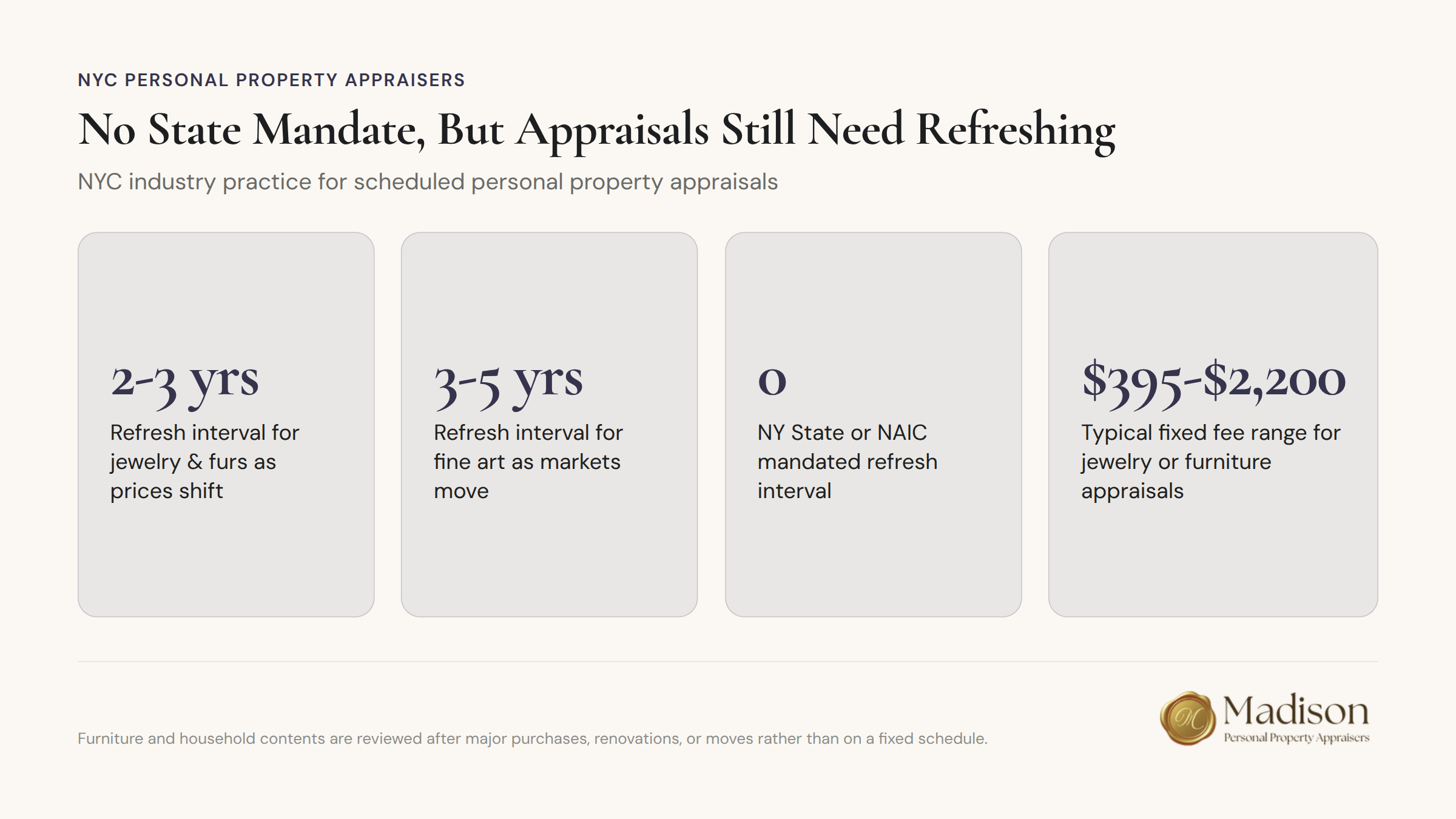
There is no New York State or NAIC-mandated interval for updating a scheduled personal property appraisal. That gap surprises a lot of policyholders, who assume there is a fixed clock running on their documentation. There isn't, but that does not mean the old number is safe to leave in place.
Industry practice in a market like New York City, where jewelry and luxury goods pricing moves quickly and the fine art market can swing significantly within a few years, is to refresh appraisals on a schedule rather than waiting for a claim to expose an outdated figure:
- Jewelry and furs: every 2 to 3 years, given how quickly precious metal prices and designer resale values shift.
- Fine art: every 3 to 5 years, since artist markets and auction results can move substantially over that window.
- Furniture and general household contents: typically reviewed whenever you make a major purchase, renovation, or move, rather than on a fixed calendar.
Our published fees for these engagements are quoted as a fixed amount after we scope the assignment, never billed hourly. Jewelry appraisals typically run $395 to $2,200 depending on the number and complexity of pieces, and fine art appraisals typically run $595 to $2,000 for standard engagements, with more complex collections priced higher. Furniture appraisals fall in a similar $395 to $2,200 typical range. The fee reflects the number of items, the depth of research required, and whether the report needs to meet a specific insurer's documentation standard, not the dollar value of what is being appraised.
The Appraisal Clause: What Happens When You and the Insurer Disagree
Most homeowners, renters, and co-op policies include an appraisal clause as a built-in dispute mechanism, separate from the initial claim investigation. If you and your insurer disagree on the amount of loss, replacement cost, or actual cash value of a damaged item, either party can typically invoke the clause. Each side selects its own appraiser, and if those two appraisers cannot agree, an umpire is brought in to resolve the difference.
It is worth being clear about what this process does and does not decide. An appraisal generally resolves the dollar amount of the loss, not whether the policy covers the loss in the first place; coverage disputes remain a separate legal or claims determination. Legal commentary on post-loss indemnity disputes notes that appraisal clauses are frequently misunderstood by policyholders who assume the process will also settle whether a claim is valid. A well-documented, standards-based appraisal prepared before a dispute arises, rather than one produced after a claim is already contested, gives both sides a clearer starting point.
Key takeaway: Fair market value and replacement cost are not interchangeable, and your policy language, not the appraisal alone, determines which one governs your payout. Getting the right standard onto your scheduled items now is far cheaper than litigating the difference after a loss.
Getting Your NYC Contents Scheduled Correctly
The practical fix is straightforward even if the underlying standards are not: know which measure your policy uses for each category of contents, and make sure your appraisal is built on that same standard. A jewelry rider that promises replacement cost needs a report anchored in current retail pricing from the marketplace you actually shop in, not a stack of decade-old receipts or a single auction comp.
Our appraisers hold credentials with organizations such as the ISA, ASA, and AAA, and every report we prepare for insurance scheduling states plainly whether the concluded figure reflects fair market value, replacement cost, or an agreed value, and why. If you are scheduling jewelry, fine art, or furnishings on a New York co-op or rental policy and need a report that matches your insurer's requirements, you can request an appraisal and we will scope the assignment before any work begins.
This article is provided for general informational purposes only and does not constitute legal, tax, or financial advice. Readers should consult a qualified attorney, CPA, or licensed insurance professional regarding their specific policy and circumstances.