
Blog
What a Qualified Appraisal for an NYC Art or Antiques Donation Must Include
Donating art, antiques, or collectibles to an NYC museum over $5,000 requires a qualified appraisal and IRS Form 8283 Section B, not just a receipt. This guide breaks down the dollar thresholds, signature requirements, and appraisal timing rules that keep your deduction defensible.
Donors giving art, antiques, or collectibles to a New York City museum, university, or cultural nonprofit often assume a gallery invoice or a family letter of provenance is enough to back up the deduction. It isn't, once the value crosses federal thresholds. A qualified appraisal donation in NYC follows the exact same federal rules that apply anywhere else in the country: the Internal Revenue Code and IRS Form 8283 govern the paperwork, not the city or the receiving institution. This guide walks through when a qualified appraisal is required, what makes an appraisal "qualified," and the specific dollar thresholds that determine what gets attached to your return.
Our certified personal property appraisers prepare USPAP-compliant valuations for donors working with NYC institutions, and the documentation rules below reflect exactly what those reports need to contain.
When Does an NYC Art Donation Need a Qualified Appraisal?
A qualified appraisal is required once the claimed deduction for a donated item, or a group of similar items, exceeds $5,000. Below that, different rules apply.
Any taxpayer whose total noncash charitable deductions for the year exceed $500 must file Form 8283 with the return. That threshold alone doesn't require an appraisal; it just requires the form. The appraisal obligation kicks in at a higher bar.
Once a single item, or a group of similar items donated to the same institution, carries a claimed value of more than $5,000, the donor must complete Section B of Form 8283 and support that value with a qualified appraisal prepared by a qualified appraiser. IRS Publication 561 is explicit on this point for art specifically: a donation of art or collectibles claimed at more than $5,000 must be supported by both a qualified appraisal and Form 8283. Skip either one and the IRS can disallow the deduction outright, absent a showing of reasonable cause.
Key takeaway: the $5,000 line is the one that matters most for NYC donors. Below it, a good-faith estimate and a receipt from the donee may suffice. Above it, the IRS wants a formal, signed, professionally prepared valuation report.
What the IRS Considers "Art" for Donation Purposes
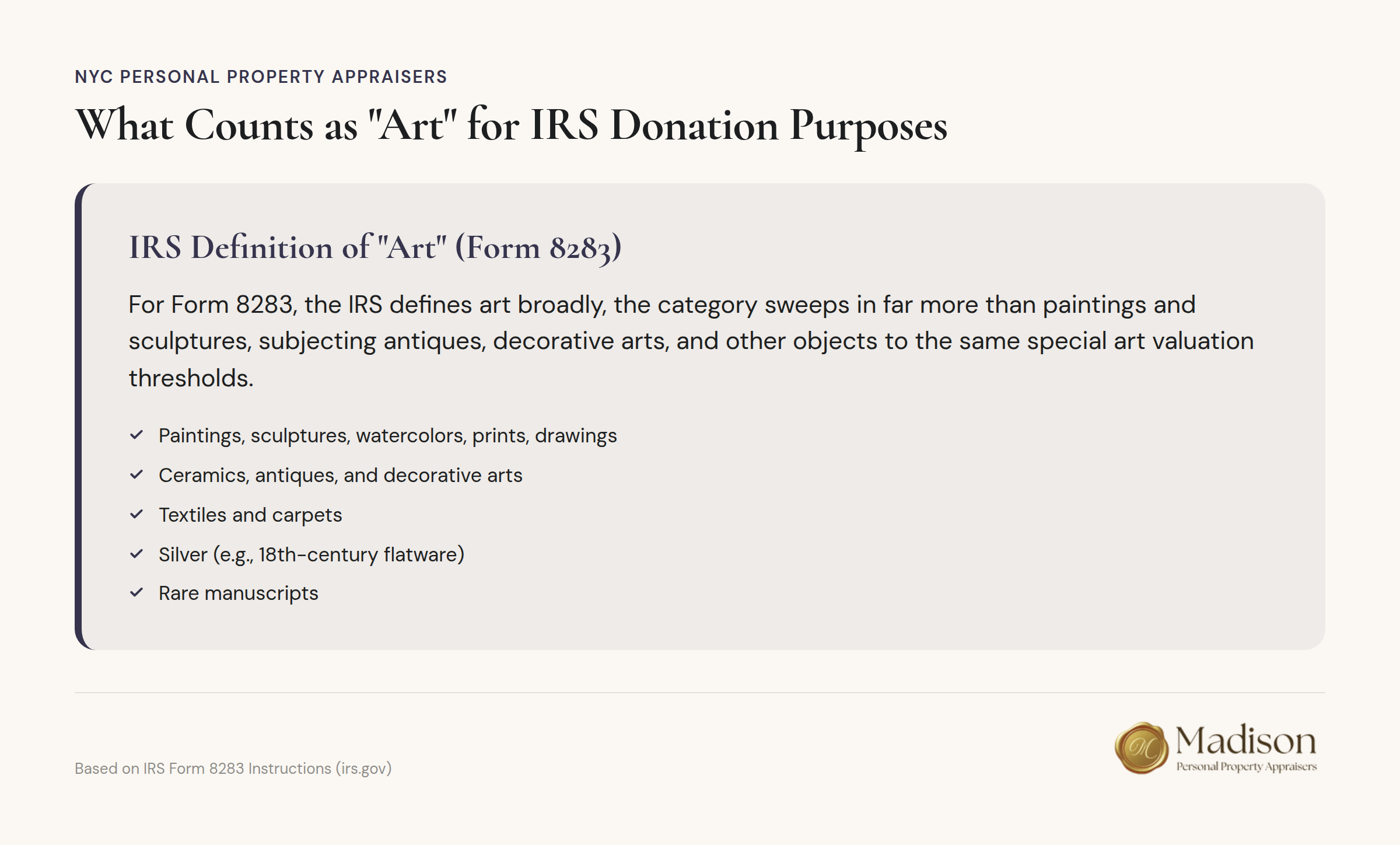
The IRS defines art broadly for Form 8283 purposes, and that definition sweeps in most of what NYC donors give to museums and cultural institutions. According to the Form 8283 Instructions, art includes paintings, sculptures, watercolors, prints, drawings, ceramics, antiques, decorative arts, textiles, carpets, silver, and rare manuscripts, among other categories.
That matters because the special art thresholds (discussed below) apply to antiques and decorative arts just as they apply to a painting or sculpture. A donor giving a set of 18th-century silver flatware to a decorative arts museum is subject to the same rules as a donor giving a modern painting. If you're unsure whether a specific object falls into a taxable-property category at all, our answer to what are the two types of personal property explains how the IRS and appraisers classify tangible items for valuation purposes.
What Makes an Appraisal "Qualified" Under Federal Rules
A "qualified appraisal" is a specific legal term, not a marketing label. Under the governing Treasury regulation, it is an appraisal document prepared by a qualified appraiser, in accordance with generally accepted appraisal standards, that meets a defined set of content and timing requirements.
A qualified appraiser, in turn, must meet education and experience requirements for the type of property being valued, must regularly perform appraisals for compensation, and cannot be the donor, the donee, a party to the transaction, or otherwise disqualified under the regulation. A detailed summary published by the American Society of Appraisers walks through these qualification standards in plain language.
In practice, this is why credentials matter for NYC art and antiques donations. Appraisers who hold designations with organizations such as the ISA, ASA, or AAA, and who prepare their reports in accordance with USPAP (the standard published by The Appraisal Foundation), are positioned to meet the regulation's requirements. A report that skips a methodology discussion, comparable sales analysis, or a signed appraiser declaration is not a qualified appraisal no matter how experienced the appraiser is, because the regulation cares about content and process, not just reputation.
Watch out: a fee arrangement based on a percentage of the appraised value disqualifies the appraisal entirely. The appraiser's fee must be fixed and disclosed, never tied to the number that ends up on your return.
The Appraisal Timing Window You Cannot Miss
The appraisal has to be signed, dated, and in the donor's hands before the due date, including extensions, of the return on which the deduction is first claimed. If the deduction is first claimed on an amended return, the appraisal must be received before that amended return is filed.
That window is narrower than most donors expect. An appraisal completed too early, well before the gift is made, can also fall outside the acceptable range under the qualified appraisal regulation. For a donor giving a painting to an NYC museum in December but not filing taxes until the following April (or October with an extension), the safest practice is to have the appraisal completed close to the date of the gift and well before the filing deadline, not scrambled together the week taxes are due.
Example: A collector donates a 19th-century landscape painting to a Manhattan museum in November 2025 and claims the deduction on her 2025 return. If she files for an extension, she has until the extended October 2026 deadline to have received a signed, qualified appraisal, but waiting that long leaves no room for revisions if the appraiser identifies a documentation gap.
Dollar Thresholds That Change What You Must Attach to Your Return
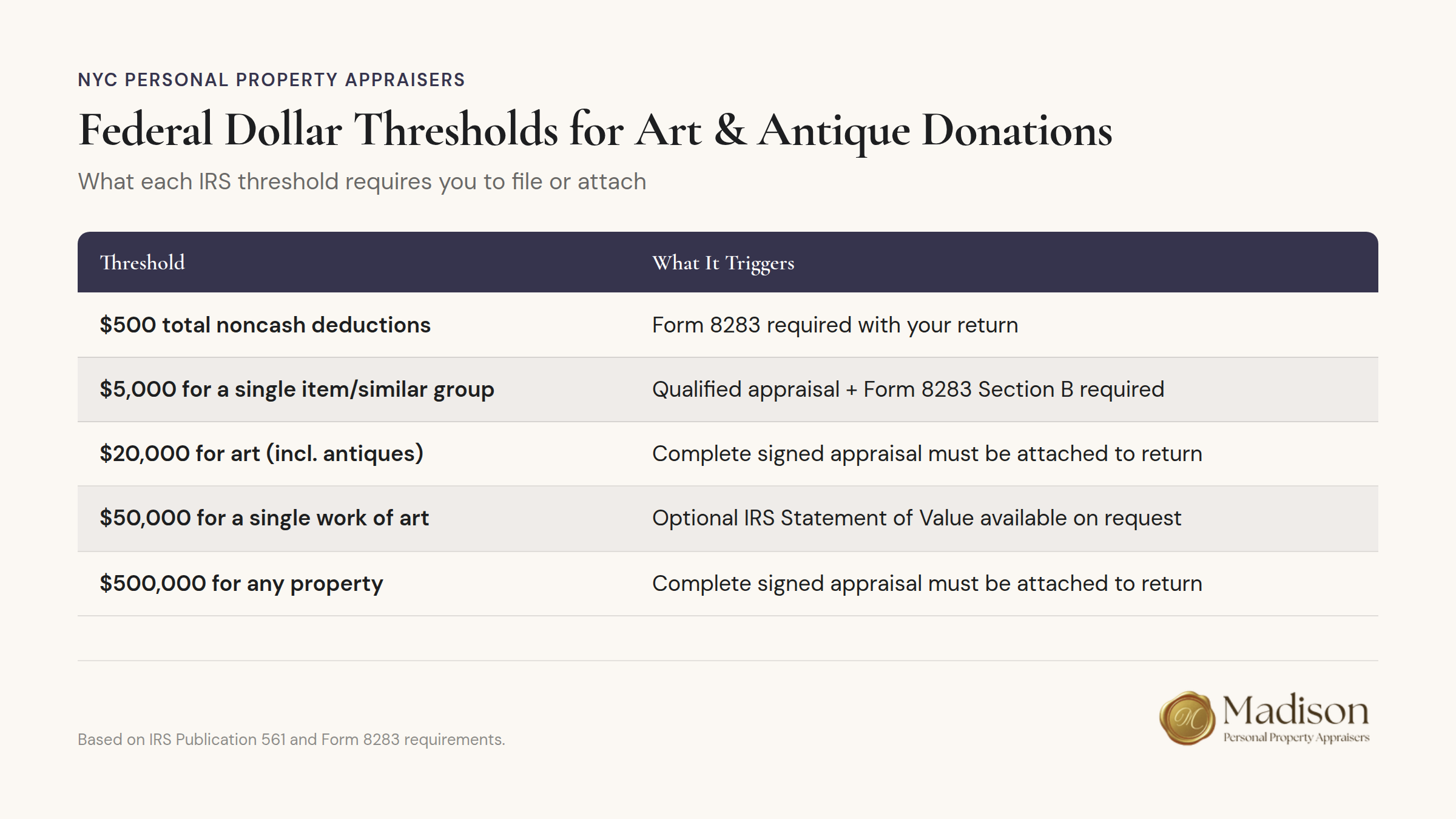
The $5,000 threshold triggers the appraisal requirement itself, but three additional thresholds determine what paperwork physically goes with your tax return.
At $20,000, art donations require the complete signed appraisal to be attached to the return, not just kept on file. Publication 561 states this directly, and it applies specifically to art, which as noted above includes antiques and decorative arts under the IRS definition. At $50,000, a single work of art becomes eligible for an optional IRS Statement of Value, requested from the IRS Art Appraisal Services before the return is filed. And at $500,000, the attachment requirement extends beyond art to any donated property: once a claimed deduction for an item or group of similar items exceeds $500,000, the signed appraisal must be attached regardless of asset category.
| Threshold | What It Triggers |
|---|---|
| $500 total noncash deductions | Form 8283 required with your return |
| $5,000 for a single item or similar group | Qualified appraisal and Form 8283 Section B required |
| $20,000 for art (including antiques) | Complete signed appraisal must be attached to the return |
| $50,000 for a single work of art | Optional IRS Statement of Value available on request |
| $500,000 for any property | Complete signed appraisal must be attached to the return |
Between $5,000 and $20,000, donors generally keep the appraisal in their own records rather than attaching it, though attaching a copy voluntarily can reduce the odds of an unnecessary audit inquiry, since the reviewer has the supporting documentation up front instead of requesting it later.
Appraiser Declaration and Donee Acknowledgment on Form 8283
Section B of Form 8283 isn't just a place to list values; it requires two separate signatures beyond the donor's own.
The appraiser must complete and sign the appraiser declaration, certifying they meet the qualified appraiser requirements and understand that a substantial or gross valuation misstatement can result in penalties against them. The donee organization, meaning the NYC museum, university, or cultural nonprofit receiving the gift, must sign Part V, acknowledging receipt of the property described. According to IRS guidance on substantiating noncash contributions, this donee signature is required for noncash gifts over $5,000, with the exception of publicly traded securities.
This three-way signature structure (donor, appraiser, donee) is what makes Section B function as a check against inflated valuations. Missing any one signature is treated the same as missing the form entirely: the deduction is at risk of disallowance.
Coordinating With NYC Museums and Cultural Nonprofits
NYC institutions that regularly accept art, antiques, and collectibles are generally well versed in signing Part V, but donors still need to manage their side of the paperwork proactively. A few practical steps make the process smoother:
- Confirm the gift date in writing with the receiving institution, since the appraisal's timing window is measured against that date, not the date the object physically arrives.
- Request high-resolution photographs be taken at the time of transfer, since the IRS can request them for items valued at $20,000 or more.
- Ask the appraiser to identify the item precisely enough that the description in the appraisal, on Form 8283, and in the museum's accession records all match.
- Route the signed appraisal and Form 8283 to the donee for Part V signature well before the filing deadline, since museum registrar offices can take weeks to process signature requests.
Any of our readers weighing whether a piece belongs in an estate inventory instead of a lifetime donation may find it useful to review how a New York estate appraisal works, since the documentation standards for estate and gift purposes overlap closely with donation appraisals.
Protect Your Deduction Before You File
The paperwork behind a qualified appraisal donation in NYC is unforgiving on deadlines and signatures, but it isn't complicated once the thresholds are clear. Know whether your donation crosses $5,000, $20,000, or $500,000, get the appraisal signed and dated inside the correct window, and make sure the appraiser and the donee institution both sign where required. Donors who treat the appraisal as a formality rather than a compliance document are the ones who end up defending a deduction after the fact instead of before it.
If you're planning a donation of art, antiques, or collectibles to an NYC museum or nonprofit, our team can request an appraisal scoped to IRS Form 8283 requirements from the outset, so the report is built to survive review rather than patched together after the fact.
This article is provided for general informational purposes only and does not constitute legal, tax, or financial advice. Readers should consult a qualified attorney or CPA regarding their specific circumstances.