
Blog
How New York's Surrogate's Court Values Personal Property in an Estate
New York's Surrogate's Court requires executors to report personal property at fair market value as of the date of death, using specific inventory categories and deadlines. This guide walks through the 22 NYCRR 207.20 filing rules, the $50,000 small estate threshold, and when a professional appraisal becomes necessary.
When someone dies owning jewelry, art, or a house full of furniture, someone has to put a dollar figure on all of it before New York's Surrogate's Court will let the estate move forward. That person is the executor or administrator, and the standard they're held to is fair market value as of the date of death, not what grandma paid for the ring or what a similar piece is listed for online. This guide covers what a personal property appraisal for surrogate's court in New York actually requires: the Inventory of Assets deadline, the small estate shortcut, the federal appraisal thresholds that follow the estate into probate, and where families run into trouble.
Executors who bring in our NYC personal property appraisers early in the process, rather than after the court has already flagged a missing or incomplete inventory, tend to avoid most of the problems described below.
What Fair Market Value Means for a Decedent's Personal Property
Fair market value is the price a willing buyer would pay a willing seller for an item, with neither party under pressure to act and both reasonably informed about the property. It is not a forced-sale or liquidation price, and it is not simply what the decedent paid or what an insurance policy lists.
For Surrogate's Court purposes, professional practice generally treats the actual sale price of an item to a genuine buyer within a reasonable time after death as strong evidence of that item's fair market value for estate reporting. Absent a sale, fiduciaries customarily rely on a qualified appraiser's opinion, especially for anything beyond ordinary household goods.
This matters because personal property covers more categories than most executors expect. If you're unsure whether an asset counts as tangible personal property or falls into a different reporting bucket, our guide on the two types of personal property breaks down the distinction the court cares about.
Pro tip: Date-of-death value is the default. If a federal estate tax return is filed or could be filed, the executor may elect an alternate valuation date six months after death for property not yet sold or distributed, but that election shifts the reporting date, not the underlying fair market value standard.
The Surrogate's Court Inventory of Assets: Your 9-Month Deadline
New York's Uniform Rules for Surrogate's Court, at 22 NYCRR 207.20, require the fiduciary or attorney of record to file an Inventory of Assets identifying everything the decedent owned, including tangible personal property, within nine months of the date letters are issued to the fiduciary, or as the court otherwise directs.
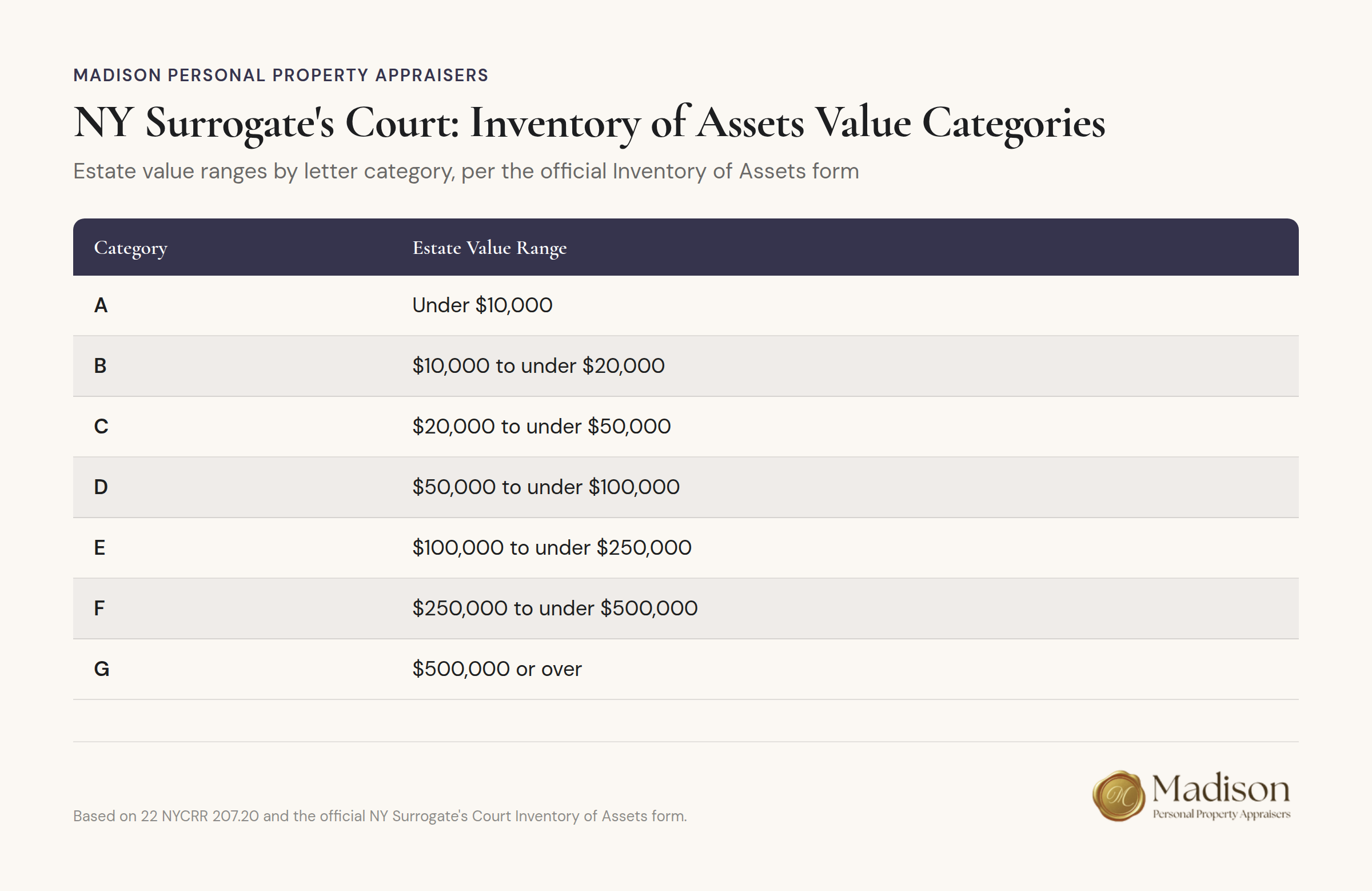
The inventory does not ask for exact dollar figures. Instead, the official Inventory of Assets form sorts the total estate value into letter categories:
| Category | Estate Value Range |
|---|---|
| A | Under $10,000 |
| B | $10,000 to under $20,000 |
| C | $20,000 to under $50,000 |
| D | $50,000 to under $100,000 |
| E | $100,000 to under $250,000 |
| F | $250,000 to under $500,000 |
| G | $500,000 or over |
The letter category still has to be supportable. If the court, a beneficiary, or the tax department later questions why an estate landed in category C instead of D, the fiduciary needs documentation behind that number, not a guess.
Watch out: Failing to file the inventory, or filing one that doesn't hold up, gives the court grounds to refuse certificates, revoke letters, and disallow the fiduciary's commissions or legal fees. This is not a formality the court treats loosely.
When Does an Estate Qualify for the $50,000 Small Estate Shortcut?
An estate qualifies for New York's small estate procedure, called Voluntary Administration, when the decedent's personal property (excluding real property) is worth $50,000 or less, as the New York State Bar Association explains. Under that threshold, a voluntary administrator can settle the estate without the formal inventory filing or judicial accounting that full probate requires.
Once personal property exceeds $50,000, or the estate includes New York real property held solely in the decedent's name, full probate or administration applies, with the formal inventory and accounting obligations described above. That's the point at which many families realize a shoebox of estimated values won't hold up, and a documented appraisal of the estate's personal property becomes the safer path.
Example: An estate with $42,000 in furniture, jewelry, and a used car qualifies for Voluntary Administration. Add a $15,000 art collection discovered later, and the estate crosses $50,000, triggering the full inventory and accounting process, categories A through G included.
Federal Appraisal Rules That Follow the Estate Into Probate
If the estate files a federal estate tax return, IRS Form 706, Schedule F requires a qualified appraisal for any single item or collection of similar items, such as art, jewelry, furs, silverware, oriental rugs, or coin and stamp collections, valued over $3,000. The appraiser's qualifications must be submitted alongside the appraisal itself.
Items worth less than $100 located in the same room can be grouped together on the schedule. Everything else generally needs to be itemized room by room. This level of detail is exactly what a court-facing personal property appraisal is built to produce, and it's a different standard than the letter-category estimates on the state inventory.
New York's Estate Tax Exemption and the Cliff That Raises the Stakes
New York's basic estate tax exclusion amount was $6,940,000 for deaths in 2024 and $7,160,000 for deaths in 2025. Unlike the federal exemption, New York applies a cliff: once the taxable estate exceeds 105% of the exclusion amount, the exemption disappears entirely and the whole estate becomes subject to tax, not just the amount above the threshold.
That cliff is why precise personal property values matter even for estates that look comfortably under the line. New York tax guidance confirms the estate follows the federal alternate valuation framework when a federal return is filed or could be filed, which means the valuation date itself can shift the numbers that determine whether an estate falls inside or outside the exemption.
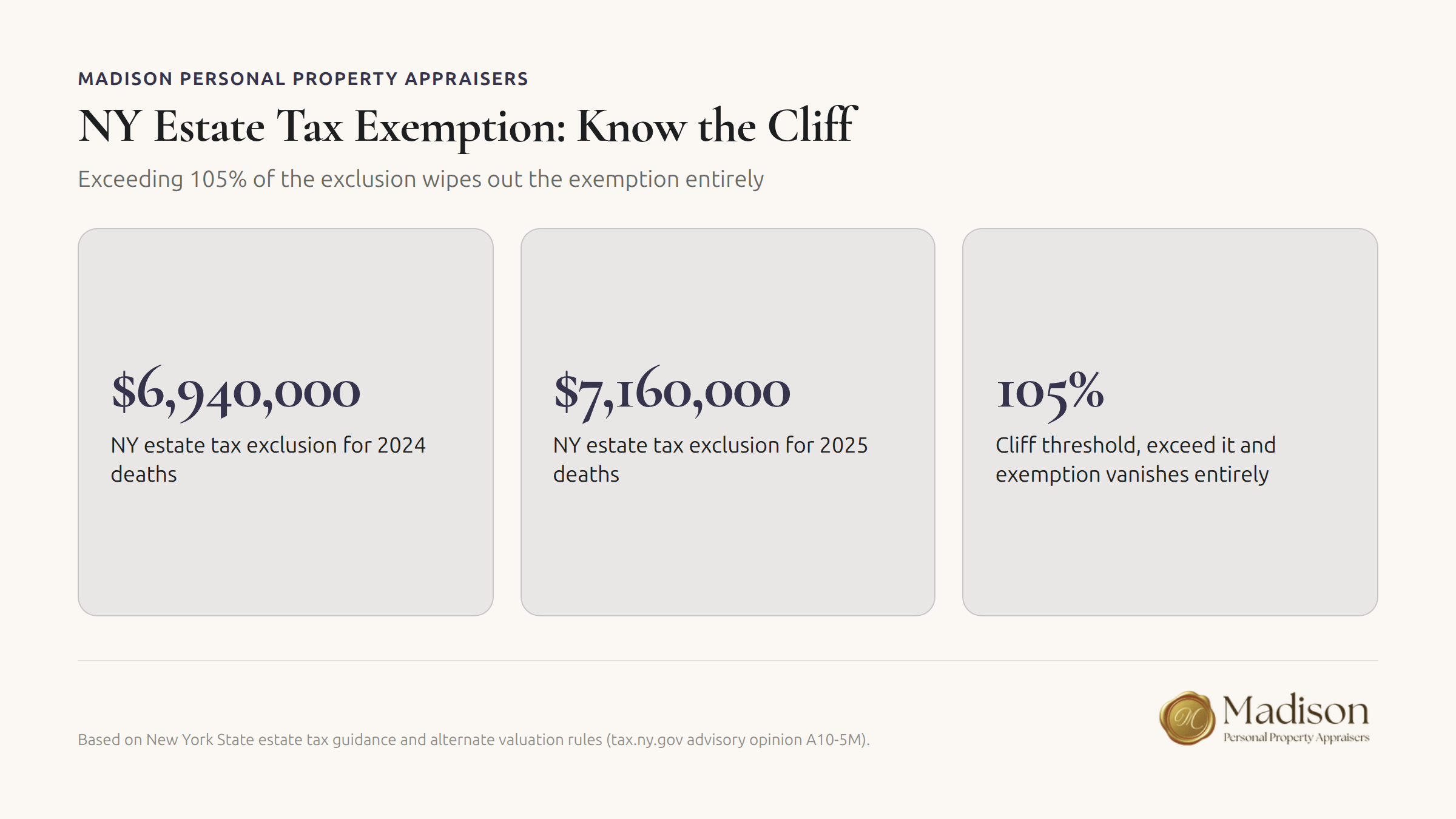
Key takeaway: An estate sitting at $7,000,000 in New York in 2025 is under the exemption. Add a $200,000 art collection appraised too generously (or too conservatively, if a beneficiary later challenges it), and the estate can cross the cliff into full taxation on every dollar, not just the excess.
Fiduciary Liability When Executors Guess at Values
Executors who estimate jewelry, art, or collectible values themselves, rather than obtaining a professional appraisal, take on personal risk. The fiduciary is the one who signs the inventory and accounting, and the guide to New York City's Surrogate's Courts makes clear that a fiduciary answers to the court, and to beneficiaries, for the accuracy of the figures filed.
If the estate is later audited by the tax department, or if a beneficiary disputes the distribution because a piece of jewelry or a painting was undervalued, an executor with only a personal estimate has little to stand on. A signed, USPAP-compliant appraisal from a qualified appraiser gives the fiduciary a defensible record instead of a guess.
How a Professional Personal Property Appraisal Supports Your Filing
Our appraisers prepare USPAP-compliant reports for estate and probate matters, valuing jewelry, art, furniture, and household collections at fair market value as of the date of death, in the format New York's Surrogate's Court and the IRS both expect. Engagements are quoted as a fixed fee after we scope the assignment, never billed hourly.
For personal property appraisals generally, fees typically start from $195 for standard reporting or $295 for the IRS-qualified reports required to support Form 706 Schedule F filings, with most estate assignments running $395 to $2,200 depending on the number and complexity of items involved. Larger or more complex collections can run higher, reflecting the depth of research and itemization the assignment requires, not the value of any single piece.
If you're managing an estate in New York and need to know who typically covers this cost, our guide on who usually pays the appraisal fee walks through how that's handled between the estate and its beneficiaries.
Getting the Valuation Right the First Time
The Surrogate's Court doesn't dictate a specific appraisal methodology, but it does enforce accurate, timely reporting, and it has real consequences (revoked letters, disallowed fees) for fiduciaries who don't deliver it. Between the 9-month inventory deadline, the $50,000 small estate threshold, and the $3,000 federal appraisal trigger, most estates with any meaningful personal property need a professional valuation somewhere in the process.
If you're serving as executor or administrator in New York and need a court-ready personal property appraisal, you can request an appraisal to get the process scoped and moving before your inventory deadline arrives.
This article is provided for general informational purposes only and does not constitute legal, tax, or financial advice. Readers should consult a qualified attorney or CPA regarding their specific circumstances.