
Blog
What Determines Personal Property Appraisal Cost in NYC: A Fee Breakdown
Personal property appraisal cost in NYC depends on item count, research depth, report format, and intended use, not a fixed price list. This guide breaks down each driver so estate executors, attorneys, and collectors know what to expect before requesting a quote.
New York City has no published fee schedule for personal property appraisals. Unlike real estate, which New York assesses under a formal statewide valuation framework, personal property such as jewelry, art, furniture, and collectibles isn't taxed or regulated the same way, so the state's property valuation guidance simply doesn't apply to it. That leaves appraisal cost to vary by assignment, and the variation is not random. Four factors consistently explain why one appraisal costs a few hundred dollars and another runs into the thousands: how many items are involved, how much research each item requires, which USPAP report format the situation calls for, and what the appraisal will actually be used for.
Our NYC personal property appraisers quote every engagement as a fixed fee after scoping the assignment, never by the hour, so understanding these drivers upfront helps you anticipate cost before you request a quote.
How Many Items Are You Appraising?
The single biggest cost driver most people think of first is scope: how many items need a documented opinion of value. A single engagement ring is a different assignment than a five-bedroom apartment full of furniture, art, silver, and decades of accumulated belongings.
Estate and probate engagements often involve dozens or hundreds of items across many categories. A photo-only inventory prepared for a probate filing, for example, covers every item in a household with a brief description and value conclusion rather than an in-depth narrative on each piece. That kind of broad inventory assignment is priced differently than a focused appraisal of three or four high-value objects, because the appraiser's time is driven by the volume of items that must be identified, researched, and documented, not by any single item's value.
How Much Research Does the Appraisal Require?
Not all items take the same amount of research to value correctly. Common household furniture, mainstream jewelry, and recent electronics usually have active retail and resale markets, so an appraiser can find comparable sales and current replacement listings relatively quickly.
Rare, high-value, or unusual items are a different story. Fine art by a lesser-known artist, antique silver with maker's marks that need identification, a firearm collection with regulatory considerations, or a piece attributed to a specific historical period all require deeper investigation:
- Provenance research: tracing ownership history or exhibition record for artwork and antiques
- Auction record analysis: pulling comparable sales from specialized auction houses rather than general retail listings
- Authentication consultation: confirming maker, period, or materials before a value opinion can be defended
- Specialized market knowledge: understanding niche collector markets that don't show up in general retail pricing
Pro tip: If you know an item in your collection is unusual, rare, or attributed to a notable maker, mention it when you request your appraisal. Flagging it up front lets the appraiser scope the research accurately instead of discovering the complexity mid-assignment.
Appraisal Report vs. Restricted Appraisal Report
USPAP recognizes two report formats, and which one your situation requires has a direct effect on cost. An Appraisal Report is the full, multi-user format: it contains the narrative, methodology, market analysis, and supporting documentation needed for anyone relying on the report besides the client, including the IRS, an insurer, a court, or opposing counsel.
A Restricted Appraisal Report is a shorter format intended for the client's own use only. It states the value conclusion with a reference to the appraiser's workfile rather than a full narrative, which takes less time to prepare. The tradeoff is that a Restricted Appraisal Report cannot be used for IRS filings, insurance claims, equitable distribution in a divorce, or litigation of any kind, because it isn't built to stand on its own for a third party who wasn't involved in the assignment.
In practice, this means the report format follows directly from who else needs to rely on the numbers. If the answer is "just me, for my own planning," a Restricted Appraisal Report may be enough. If the answer includes the IRS, an insurance adjuster, a judge, or opposing counsel, an Appraisal Report is required, and that additional documentation adds to the fee.
Why Intended Use Is the Biggest Driver of Cost
Intended use sits above item count and research depth as the single factor most responsible for cost differences between two otherwise similar engagements. The same set of furniture appraised for a homeowner's own reference costs less to document than the identical furniture appraised for a contested divorce, because the second assignment must survive scrutiny from a second attorney and possibly a judge.
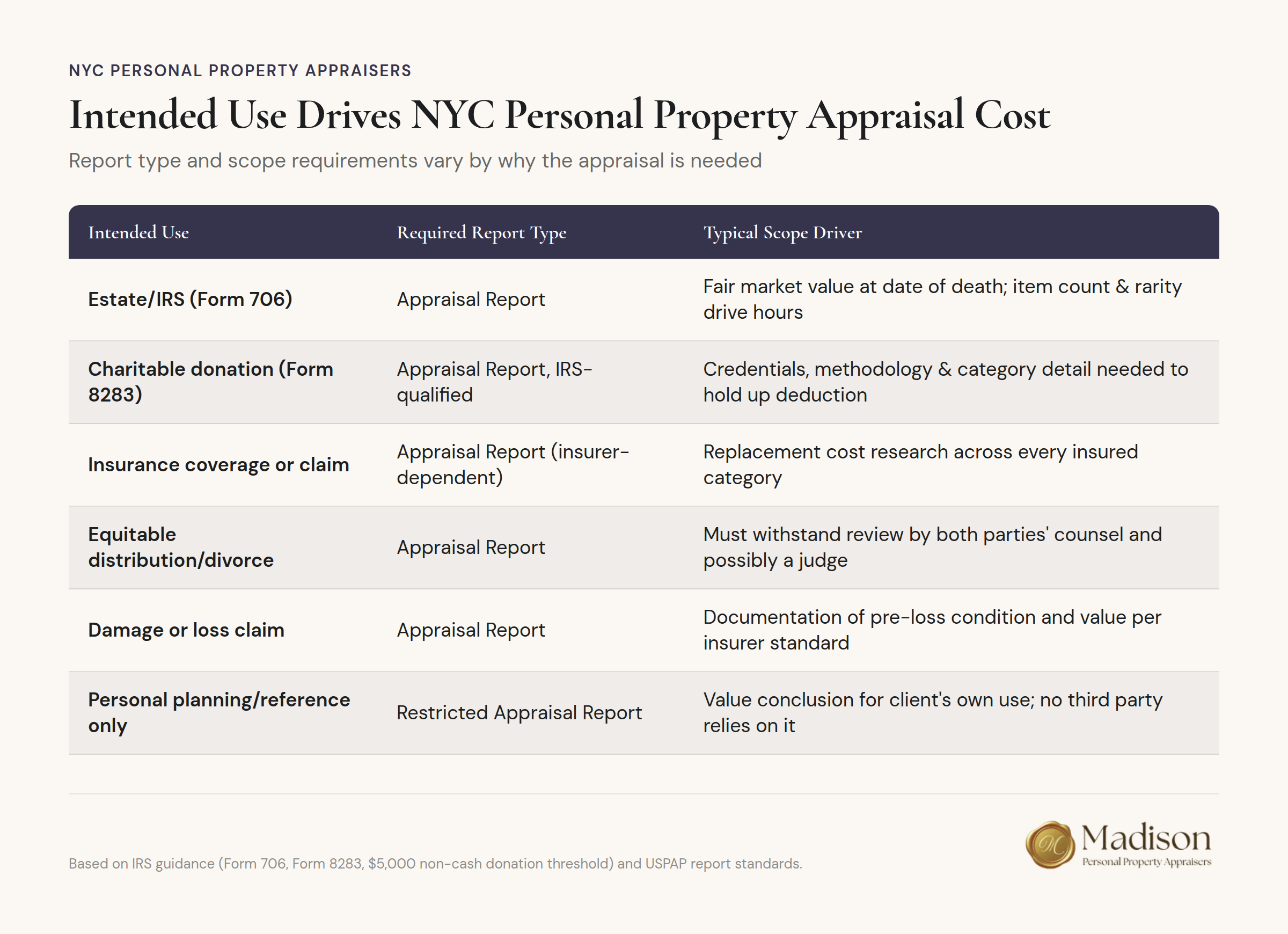
Each intended use carries its own documentation standard:
| Intended Use | Required Report Type | Typical Scope Driver |
|---|---|---|
| Estate/IRS (Form 706, date-of-death value) | Appraisal Report | Fair market value for every asset as of a specific date; item count and rarity drive hours |
| Charitable donation (IRS Form 8283) | Appraisal Report, IRS-qualified | Appraiser credentials, methodology, and category-specific detail required for the deduction to hold up |
| Insurance coverage or claim | Appraisal Report (insurer-dependent) | Replacement cost research across every insured category |
| Equitable distribution/divorce | Appraisal Report | Must withstand review by both parties' counsel and, potentially, a judge |
| Damage or loss claim | Appraisal Report | Documentation of pre-loss condition and value to the standard the insurer requires |
| Personal planning or reference only | Restricted Appraisal Report | Value conclusion for the client's own use; no third party will rely on it |
Estate settlements that fall under New York's estate tax exemption threshold still typically need a full Appraisal Report if the executor or the Surrogate's Court will rely on the figures, since the report has to satisfy a party beyond the person who requested it. Donations above the IRS's $5,000 threshold for non-cash charitable contributions require a qualified appraisal under IRS guidance, which is an Appraisal Report by definition. A quick reference-only valuation for your own records, by contrast, can often use the lighter Restricted format.
What This Means for Your NYC Appraisal Fee
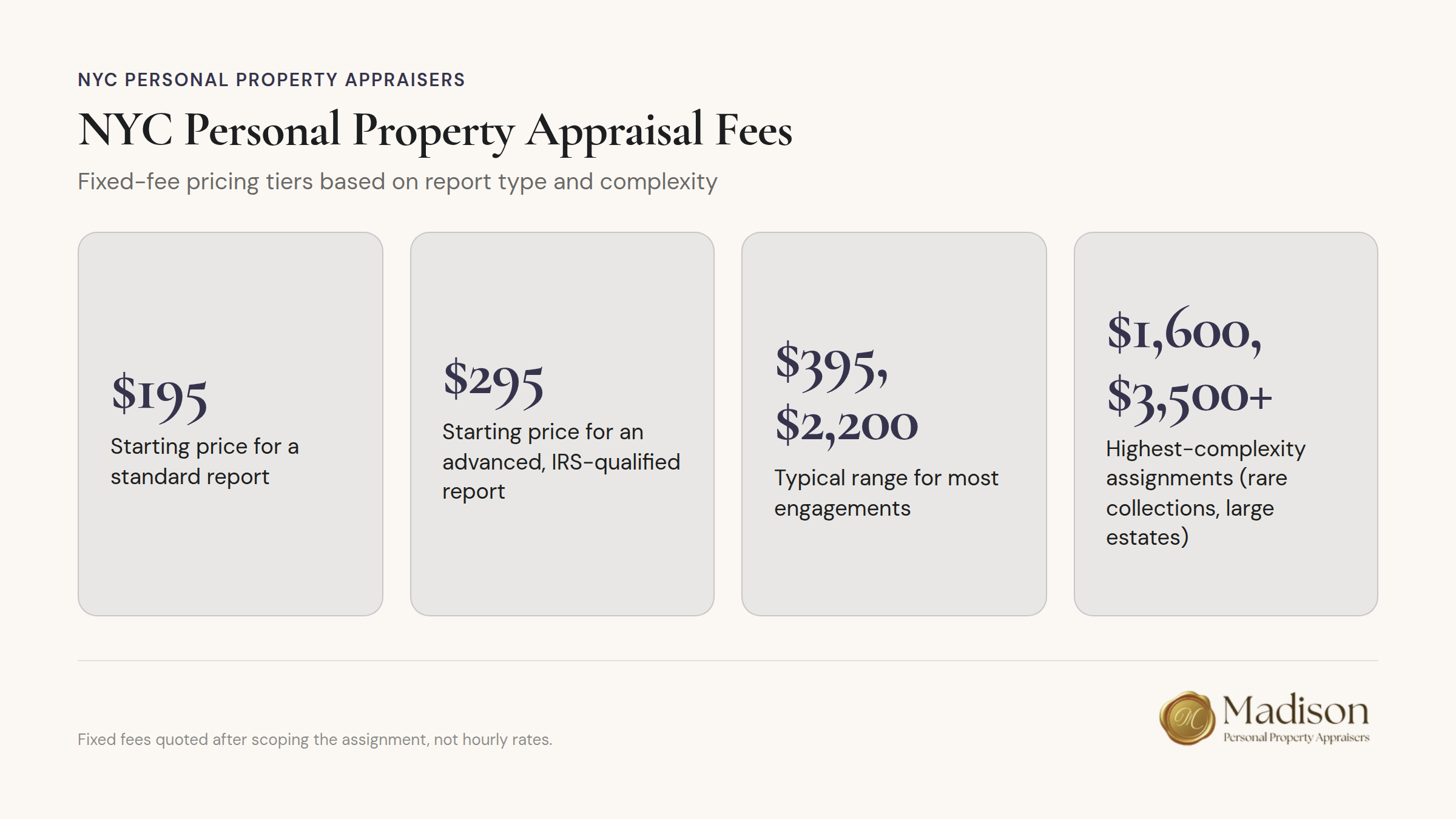
Our personal property appraisals in New York City start at $195 for a standard report and $295 for an advanced, IRS-qualified report, with most engagements running $395 to $2,200 depending on item count, research depth, and report format. The most complex assignments, rare collections, extensive estates, or highly specialized categories, typically run $1,600 to $3,500 or more.
These figures reflect a fixed fee quoted after we scope your assignment, not an hourly rate. That differs from how many appraisers in the broader market price their work: some NYC-area appraisal firms publish hourly rates with separate charges for inspection time, research, and travel, which can make the final invoice hard to predict until the work is done. A fixed fee removes that uncertainty; you know the cost before the appraiser begins.
Key takeaway: Item count sets the floor, research depth adjusts it upward for unusual items, and intended use determines which report format is legally usable, which is often the biggest swing factor of all. For more on how appraisal fees work in New York generally, see our guide to appraisal fees in NY.
Credentials Matter in an Unregulated Profession
Personal property appraisal is not a licensed profession in New York the way real estate appraisal is. New York State charges real estate appraisers application, exam, and re-examination fees and requires state certification, but no equivalent licensing structure exists for personal property appraisers. Anyone can call themselves a personal property appraiser.
That makes credentials the real differentiator. Look for appraisers who hold designations from organizations such as the International Society of Appraisers (ISA), the American Society of Appraisers (ASA), or the Appraisers Association of America (AAA), and who prepare every report in accordance with USPAP. Those credentials signal that the appraiser has completed formal valuation training, follows a documented methodology, and can defend the report's conclusions if the IRS, an insurer, or a court ever asks how the value was reached.
Watch out: A low quote from an uncredentialed appraiser can end up costing more in the long run if the report is later rejected for an IRS filing, an insurance claim, or a divorce proceeding, because the assignment then has to be redone by a qualified appraiser under a tighter deadline.
When you're ready to scope your own assignment, our team can walk through your item count, research needs, and intended use before quoting a fixed fee, so there are no surprises once the work begins. You can also review who typically pays the appraisal fee in situations involving multiple parties, such as an estate or a divorce.
This article is provided for general informational purposes only and does not constitute legal, tax, or financial advice. Readers should consult a qualified attorney or CPA regarding their specific circumstances.