
Blog
New York Inventory of Assets: What Form I-1 Actually Requires for Personal Property
New York's Surrogate's Court Inventory of Assets asks for personal property values in broad dollar bands, not itemized figures, and filing it correctly does not require hiring an appraiser. Here's what Form I-1 actually demands, when a band estimate is enough, and when you need a real appraisal to survive an IRS audit or a dispute among heirs.
When a fiduciary opens an estate in New York, one of the first court deadlines is the Inventory of Assets. Many executors assume this means hiring someone to walk through the decedent's home and assign a dollar value to every lamp, ring, and bookshelf. It doesn't. New York's statewide rule asks for something much blunter: a value band for each asset class, not a line-item appraisal.
The filing is governed by 22 NYCRR Rule 207.20, one of the Uniform Rules for the Surrogate's Court, and it applies the same way in every county. There is no separate Manhattan version or Brooklyn version. The official document is Form I-1, and understanding exactly what it asks for (and what it doesn't) saves executors from both over-spending on appraisals the court doesn't require and under-preparing for the moments when a real one is necessary. We cover how the court treats personal property values more broadly in our guide to how Surrogate's Court values personal property in an estate, but this piece focuses specifically on what Form I-1 itself requires.
What New York's Inventory of Assets Form Actually Requires
Form I-1 requires the fiduciary, or the attorney of record, to report the estate's probate assets by category and to furnish the completed form to the Surrogate's Court within 9 months after letters are issued, unless the court directs otherwise. That deadline runs from the date letters testamentary or letters of administration are granted, not from the date of death.
The form organizes probate property into asset classes rather than a running itemized list. Typical categories include:
- Real estate owned by the decedent individually
- Stocks and bonds
- Insurance payable to the estate
- Retirement accounts payable to the estate
- Mortgages, notes, and other receivables
- Cash
- Miscellaneous tangible personal property
- Firearms, reported separately
For each category, the fiduciary states a value band rather than a precise figure, and the form also asks whether the estate includes certain types of nonprobate property. Taxpayer ID numbers and financial account numbers are redacted on the public filing down to the last permitted digits, which is a basic privacy protection built into the rule itself.
The Value Bands: Categories A Through G
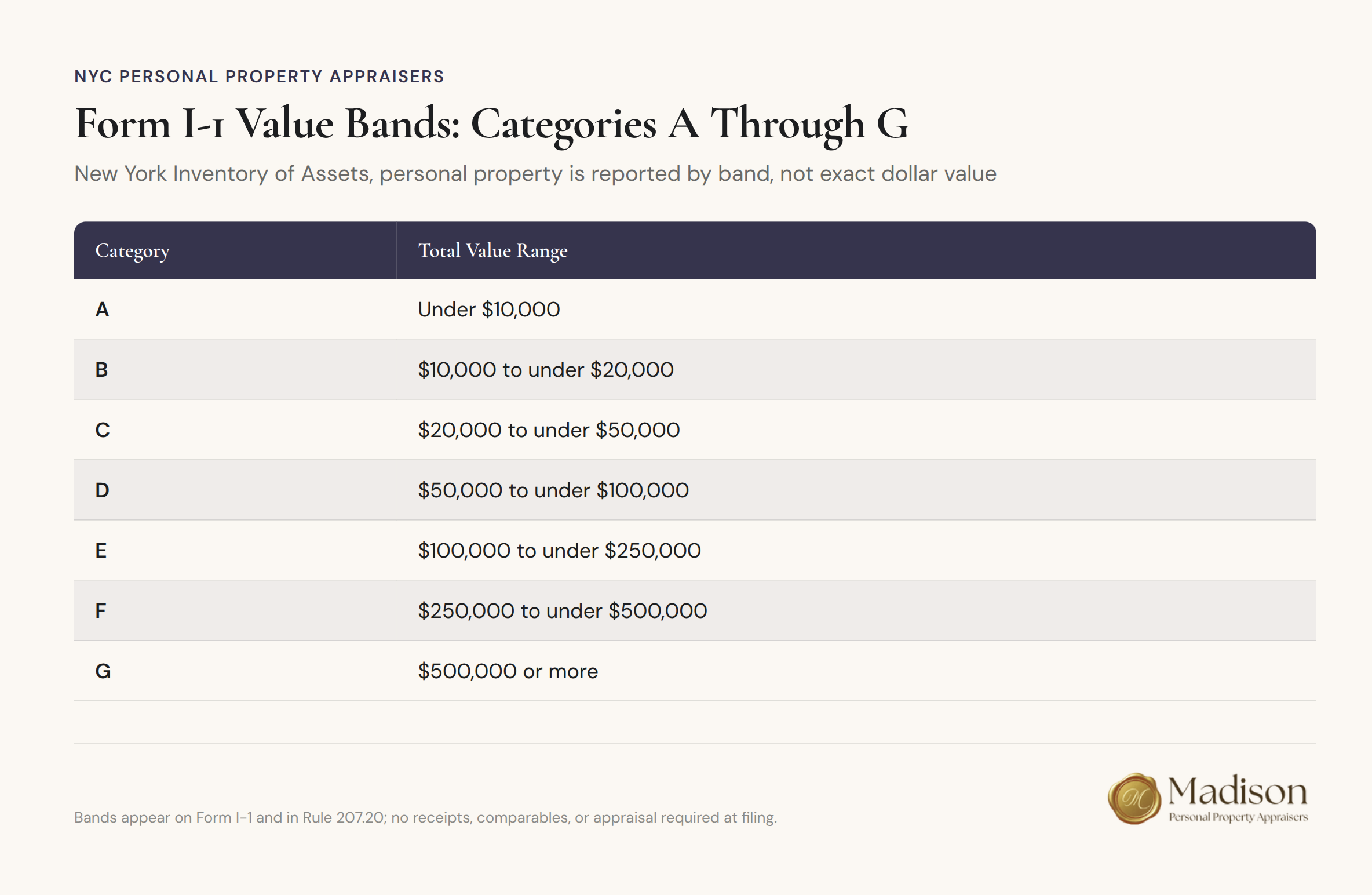
Form I-1 does not ask what the decedent's furniture, jewelry, or miscellaneous household property is worth to the dollar. It asks which letter band the total value falls into, for the estate overall and in some cases by category. The bands run as follows:
| Category | Total Value |
|---|---|
| A | Under $10,000 |
| B | $10,000 to under $20,000 |
| C | $20,000 to under $50,000 |
| D | $50,000 to under $100,000 |
| E | $100,000 to under $250,000 |
| F | $250,000 to under $500,000 |
| G | $500,000 or more |
These bands appear both on the form and in Rule 207.20 itself. A fiduciary who reasonably estimates that a decedent's household contents, jewelry, and miscellaneous personal property fall somewhere between $20,000 and $50,000 simply marks Category C. There is no requirement to justify that estimate with receipts, comparable sales, or a signed appraisal report at the point of filing.
The Nonprobate Property Section: Yes or No, Not Dollar Amounts
Form I-1 also asks the fiduciary to flag whether the estate includes nonprobate property: assets held in trust, assets subject to a beneficiary designation, jointly owned property, and other property that passes outside probate. This section is answered with a yes or no, not a dollar figure, and nonprobate assets are never added into the Category A through G total.
That distinction matters because families sometimes assume everything the decedent owned, a jointly titled bank account, a life insurance policy with a named beneficiary, a revocable trust asset, has to be valued and folded into the estate total. It doesn't, at least not on this form. The yes/no answers exist so the court (and, later, tax authorities) know where to look for a fuller accounting of the decedent's full economic picture, separate from what is actually passing through probate.
Do You Need an Appraiser Just to File the Inventory of Assets?
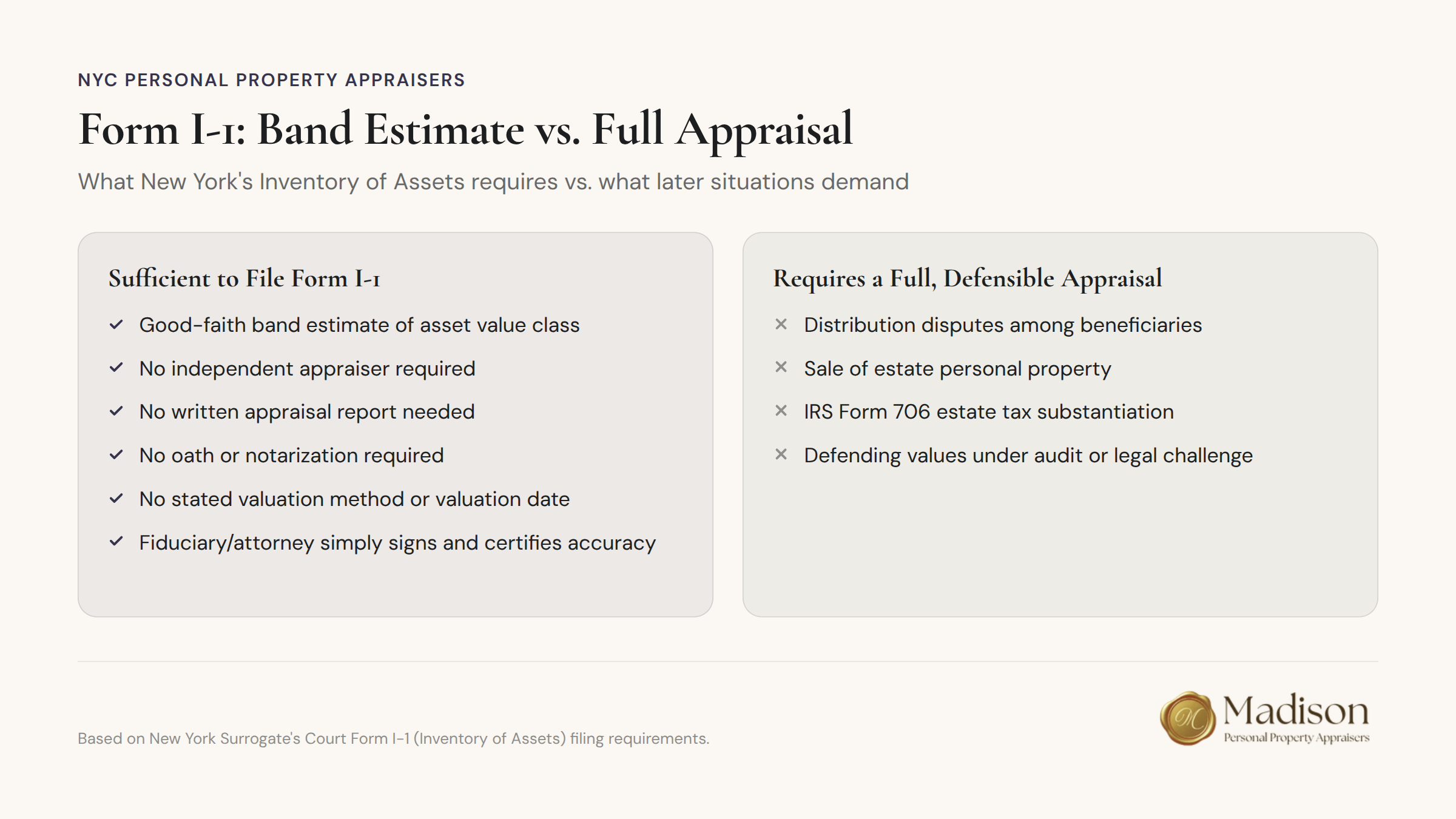
No. For the Inventory of Assets filing itself, Form I-1 does not require an independent appraiser, a written appraisal report, an oath, notarization, or even a stated valuation method or valuation date. The fiduciary or attorney simply signs and certifies that the information is true to the best of their knowledge. A reasonable, good-faith estimate of which band an asset class falls into is sufficient for this particular filing.
That said, we hear the same question from almost every executor managing a New York estate: is a casual walk-through estimate really good enough? For the court form, yes. For anything that happens after the form is filed, not necessarily. Our guide on how an estate appraisal works walks through the difference between a band estimate adequate for a court filing and a defensible, documented valuation an executor may need later.
Key takeaway: Filing Form I-1 correctly and defending the estate's personal property values under audit or dispute are two different standards. The form only requires the first.
When a Band Estimate Isn't Good Enough: Distribution, Sale, and IRS Form 706
The gap between "good enough for the court form" and "good enough everywhere else" shows up in three common situations.
Dividing personal property unevenly among heirs. If three siblings are splitting a parent's jewelry, art, and furniture, and the split isn't equal item for item, someone eventually has to agree on what each item is actually worth. A Category C band on a court form ("somewhere between $20,000 and $50,000") tells heirs nothing about whether the antique dresser is worth more than the diamond ring they're each trying to claim. Equitable distribution requires real, item-level fair market values, not a court-filing band.
Selling or liquidating estate property. An executor deciding whether to auction a collection, consign artwork, or sell a vehicle needs a current, defensible value to justify the sale price to beneficiaries and, if challenged, to the court. A band estimate from the Inventory of Assets filing offers no support for that decision.
Substantiating federal estate tax on IRS Form 706. This is where the stakes get sharpest. Per the IRS Form 706 instructions, any single item of personal property, or any collection of similar items, valued over $3,000 generally requires a written appraisal from a qualified appraiser under Treasury Regulation 20.2031-6(b). Reported values that come in at or below 65% of the correct value can trigger a 20% accuracy-related penalty under the tax code's valuation misstatement provisions, and that penalty rises to 40% for a gross valuation misstatement at or below 40% of correct value, generally where the attributable underpayment on the estate exceeds $5,000.
Example: An estate reports a collection of mid-century furniture and silver at $18,000 on Form 706. An IRS examiner's qualified appraisal values the same collection at $30,000, which is 60% of the examiner's figure, below the 65% threshold. The estate could face a 20% penalty on the resulting underpayment, on top of the additional tax owed.
This is exactly the gap between the Inventory of Assets filing and a true appraisal. The court form never asks for a valuation method or a qualified appraiser. The IRS does, once the dollar threshold is crossed. Our appraisers prepare both standard reports and IRS-qualified reports for New York estates, and because these engagements are quoted as a fixed fee scoped to the assignment rather than billed hourly, an IRS-qualified personal property appraisal typically starts from $295, with the final fee set by the number of items, the quality of existing records, and the depth of analysis the estate requires.
Firearms and Confidential Filings
If the estate includes firearms, Form I-1 calls for a separate Firearms Inventory rather than listing them with other miscellaneous property. New York restricts who can view or copy that separate filing, which keeps a detailed list of a decedent's firearms out of the general public record that otherwise attaches to probate filings. Fiduciaries handling estates with firearms should treat that schedule as its own filing requirement, not an afterthought folded into the miscellaneous property category.
What Happens If You Miss the 9-Month Deadline
Missing the filing deadline has real consequences, even though the form itself is relatively simple to complete. A Surrogate's Court can withhold certificates the fiduciary needs to transfer assets, decline to renew or can revoke letters testamentary or letters of administration, and disallow fiduciary commissions or attorney's fees tied to the estate. None of those outcomes require a dispute among heirs or a tax audit. They follow directly from an incomplete court record.
Fiduciaries juggling a death in the family, probate paperwork, and a 9-month clock sometimes let the Inventory of Assets slip because it looks like a formality compared to tax filings or creditor claims. The court treats it as a real obligation, and the penalties for ignoring it fall on the fiduciary personally, not just the estate.
Filing the Form Is the Floor, Not the Ceiling
Form I-1 sets a low bar on purpose: a band estimate, a yes/no nonprobate disclosure, a signature, filed within 9 months. That bar is appropriate for a court record meant to confirm an estate's rough size, not to settle every dollar question that will come up during administration. The moment heirs disagree over who gets what, an executor needs to sell estate property, or the estate crosses into federal estate tax territory, the standard changes completely.
Our appraisers work with New York fiduciaries on both ends of that line: band-level guidance for the court filing and full, USPAP-compliant, IRS-qualified reports when an estate needs documentation that will hold up to a sibling's objection or an IRS examiner's second opinion. If your estate is approaching either situation, request an appraisal and our team can scope exactly what the assignment requires.
This article is provided for general informational purposes only and does not constitute legal, tax, or financial advice. Readers should consult a qualified attorney or CPA regarding their specific circumstances.