
Blog
New York Estate Tax and Personal Property: What Counts Toward the Exemption Threshold
New York's estate tax exemption is far lower than the federal exemption, and every category of personal property, from art to furniture to jewelry, rolls into the taxable estate that gets measured against it. Here's what counts, what the 2024-2025 thresholds are, and why the appraised value of tangible assets can decide whether an estate owes tax at all.
New York's estate tax works on a different scale than the federal estate tax, and that difference catches a lot of families off guard. An estate that would owe nothing to the IRS can still owe tens of thousands of dollars to New York State, because the state's exemption is a fraction of the federal one. Personal property, everything from a co-op's furnishings to a coin collection to a set of estate jewelry, counts directly toward the total that gets measured against that lower threshold.
This matters most to executors and family members handling a New York estate for the first time. If you're sorting through a parent's or spouse's belongings while also filing paperwork, you need to know which items actually move the needle on the tax return. We prepare estate appraisals for New York families and their attorneys and CPAs, and the question we hear most often is some version of "does this stuff actually count?" The answer, almost always, is yes.
How New York Defines the Taxable Estate
New York ties a resident's gross estate directly to the federal gross estate definition. Under New York Tax Law, the gross estate of a deceased resident means the federal gross estate as defined in the Internal Revenue Code, whether or not a federal estate tax return is actually required. In practice, that means almost every property interest a person owned at death gets pulled into the calculation first, and exclusions get applied afterward.
From that starting point, New York allows most of the same deductions the federal estate tax return allows (debts, funeral and administration costs, the marital deduction, charitable deductions), with one notable limit: those deductions are restricted when they relate to real or tangible personal property located outside New York. For a New York resident decedent, though, the personal property itself, wherever it's located, generally counts toward the New York taxable estate regardless of where it physically sits.
Which Types of Personal Property Count Toward the Threshold?
For a New York resident's estate, both tangible and intangible personal property count toward the taxable estate used to measure the exemption threshold, with only narrow exceptions.
Tangible personal property is corporeal, physical property you can touch and move. It's the category most families think of first, and it's also the category most likely to need a professional valuation because there's no brokerage statement or bank record to point to.
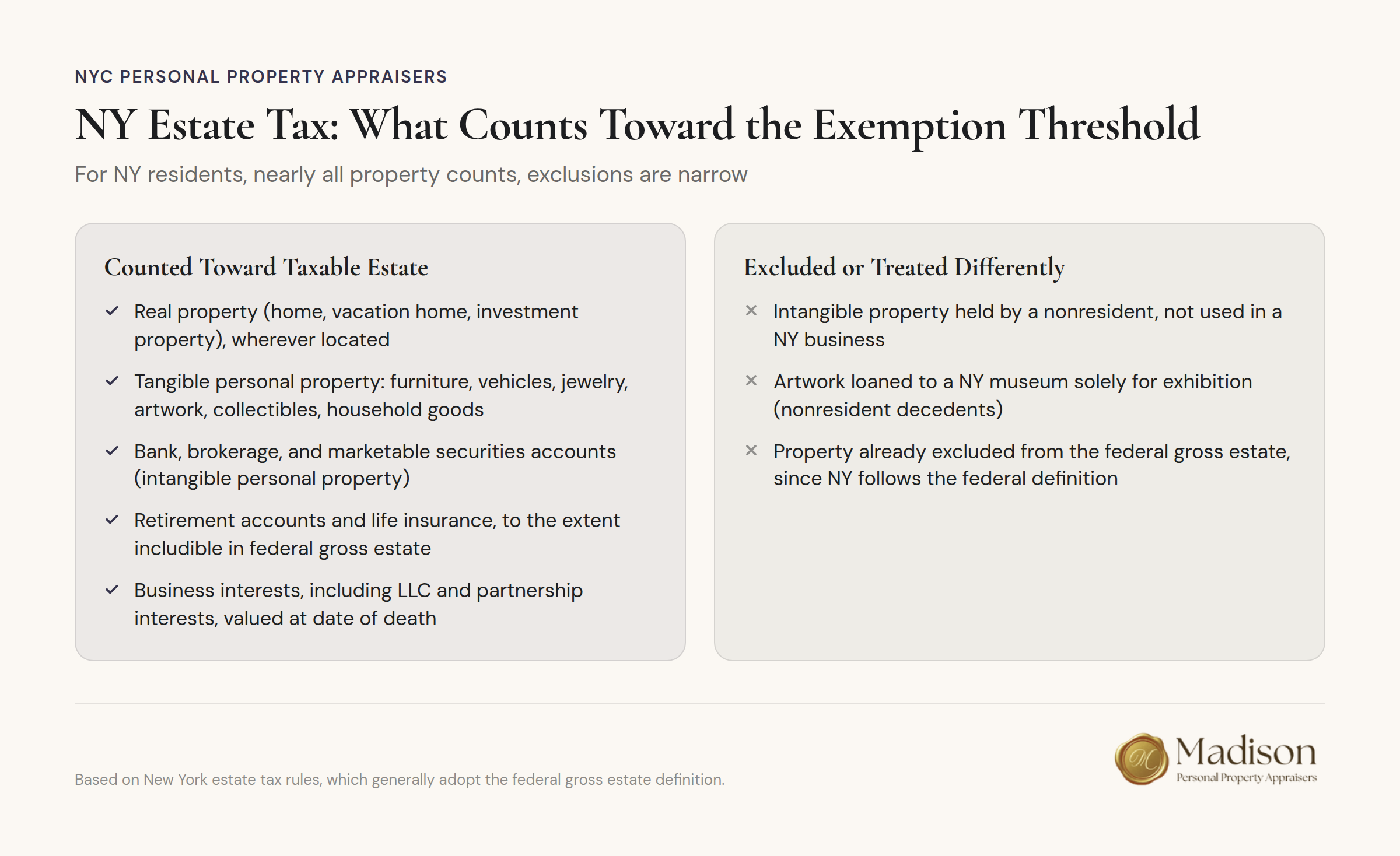
Counted toward the New York taxable estate:
- Real property, including a primary residence, vacation home, or investment property, wherever located
- Tangible personal property, such as furniture, vehicles, jewelry, artwork, collectibles, and household goods
- Bank accounts, brokerage accounts, and marketable securities, which New York classifies as intangible personal property
- Retirement accounts and life insurance to the extent they're includible in the federal gross estate
- Business interests, including LLC and partnership interests, valued as of the date of death
Excluded or treated differently in specific situations:
- Intangible personal property held by a nonresident decedent not employed in a New York business is generally excluded from that nonresident's New York taxable estate
- Works of art loaned to a New York museum solely for exhibition are excluded from a nonresident's New York taxable estate
- Property that federal law itself excludes from the gross estate never enters the New York calculation, since New York's definition borrows the federal one
For residents, the practical takeaway is simple: nearly everything counts. A coin collection, a set of silver, a home's furnishings, and a car all belong on the return alongside the bank accounts and the house.
New York's Exemption vs the Federal Estate Tax Exemption
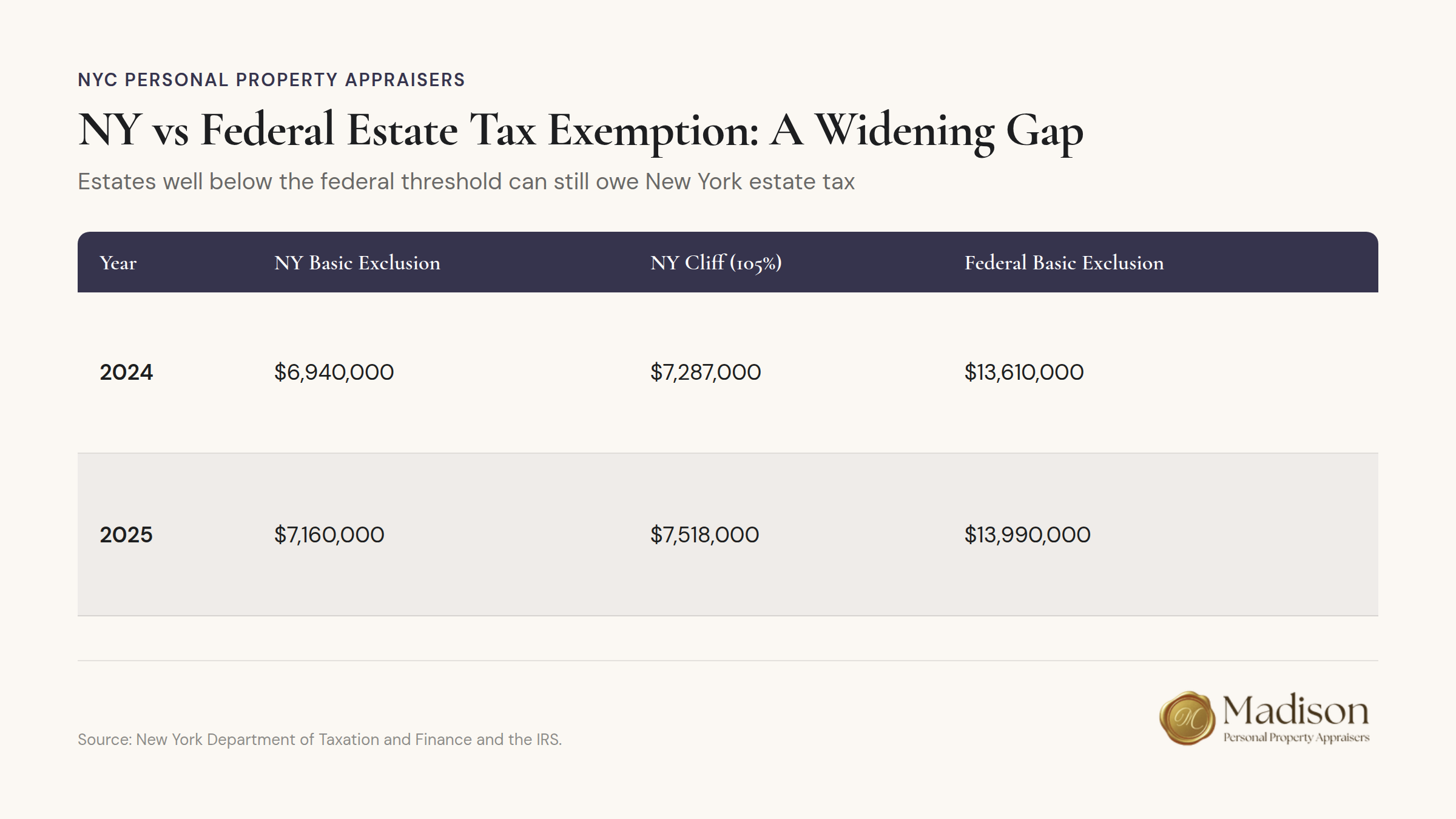
The gap between New York's exemption and the federal exemption is the reason so many "modest" estates end up owing New York estate tax. The New York Department of Taxation and Finance sets the basic exclusion amount at $6,940,000 for deaths in 2024 and $7,160,000 for deaths in 2025. The federal basic exclusion amount for 2025, by contrast, is $13,990,000 per person, according to the IRS.
That means an estate worth $8 million in 2025 owes nothing to the federal government but is well into New York estate tax territory, since it sits nearly $850,000 above the state exclusion.
| Year | NY Basic Exclusion | NY Cliff (105% of Exclusion) | Federal Basic Exclusion |
|---|---|---|---|
| 2024 | $6,940,000 | $7,287,000 | $13,610,000 |
| 2025 | $7,160,000 | $7,518,000 | $13,990,000 |
New York also has no gift tax add-back rule pulling lifetime gifts back into the estate the way some other states do, but that's cold comfort given how much lower the base exemption already is. Estates comfortably under the federal radar routinely land squarely inside New York's tax zone.
The New York "Cliff": Why Crossing the Line Costs More Than the Excess
New York doesn't tax an estate only on the amount above the exemption; it uses a cliff. If the taxable estate exceeds 105% of the basic exclusion amount, the exemption disappears entirely and the state taxes the full value of the estate, not just the portion above the threshold, as described by estate planning attorneys covering the rule.
For 2025, that cliff point is $7,518,000 (105% of $7,160,000). An estate valued at $7,517,000 keeps its full exemption and may owe little or nothing. An estate valued at $7,519,000, just $2,000 higher, loses the exemption completely and gets taxed on the entire amount.
Because almost any category of asset can push a total across that line, including real property, cash, vehicles, and personal possessions like art and jewelry, the value assigned to a household's contents or a collection is rarely a minor detail on the return. It can be the difference between owing tax and owing nothing, or between a modest bill and a much larger one.
Watch out: A rough guess at furniture, jewelry, or collectibles is a common way estates get caught by the cliff without realizing it until the return is already filed.
Why the Value You Report for Personal Property Matters
New York's Form ET-706 requires the fair market value of the entire gross estate, including tangible personal property such as art, jewelry, furniture, collectibles, and vehicles, valued as of the date of death or, if the alternate valuation date is elected under IRC Section 2032, six months after death. Fair market value, in the sense the tax code uses it, is the price a willing buyer would pay a willing seller when neither is under any compulsion to act.
That standard doesn't leave room for sentimental value, replacement cost at a retail shop, or a family member's best guess. Because the personal property line rolls directly into the taxable estate total, an appraisal that understates value can needlessly leave money on the table in planning discussions, and one that overstates value can push an estate over the cliff and trigger tax on the full amount instead of just the excess.
We prepare fair market value appraisals of estate personal property, and our reports follow USPAP (the Uniform Standards of Professional Appraisal Practice). Our appraisers hold credentials with organizations such as the ISA, ASA, and AAA. As with other estate matters we've covered, the surrogate's court process in New York often looks to the same fair market value standard when contents are disputed among heirs, so getting the number right early avoids relitigating it later.
Fees for these engagements are quoted as a fixed fee after we scope the assignment, never billed hourly. For personal property estate appraisals, typical engagements run from $395 to $2,200 depending on the number of items, the condition of existing records, and the depth of analysis the intended use requires; larger or more complex collections can run $1,600 to $3,500 or more. Scope, not the dollar value of any single item, drives the fee.
Getting the Threshold Calculation Right
An executor's first job with a New York estate is figuring out whether a return is even required, and that answer depends on adding up categories of property that don't always come with a paper trail. Bank and brokerage statements are easy. A home full of furniture, art, and decades of accumulated belongings is not.
If an estate is anywhere near New York's exclusion amount, treat the personal property inventory with the same seriousness as the bank accounts. A defensible, professionally prepared valuation gives an executor and the estate's attorney or CPA a number they can stand behind, whether the estate ends up well under the threshold or squarely on the other side of it. Request an appraisal from our team to get a fixed-fee quote scoped to your estate's inventory.
This article is provided for general informational purposes only and does not constitute legal, tax, or financial advice. Readers should consult a qualified attorney or CPA regarding their specific circumstances.