
Blog
Why New York's Estate Tax Cliff Makes Personal Property Valuation So High-Stakes
New York's estate tax cliff can turn a $12,000 valuation difference into a full estate tax bill instead of zero. Here's how the 105% threshold works and why a defensible appraisal of art, jewelry, and collectibles matters more in New York than almost anywhere else.
Most people assume that going a little over an estate tax exemption means paying tax on the amount over the line. New York doesn't work that way. Cross a specific threshold by even a few thousand dollars and the entire estate, not just the excess, becomes taxable. That mechanism is often called the New York estate tax cliff, and it makes the valuation of personal property, art, jewelry, and collectibles far more consequential here than in states that tax only the amount above an exemption.
This matters directly for estates that include meaningful personal property. Our guide to what counts toward the New York estate tax exemption threshold covers which assets get included in the calculation in the first place. This article focuses on what happens once those assets are counted: how the cliff mechanism itself works, and why an informal estimate of a $50,000 art collection can be the exact margin that decides whether an estate owes nothing or owes tax on every dollar it holds.
What Is New York's Estate Tax Cliff?
New York's estate tax cliff eliminates the entire basic exclusion amount once a taxable estate exceeds 105% of that exclusion. Below the exclusion, an estate owes no New York estate tax. Between 100% and 105% of the exclusion, the benefit phases out gradually. Above 105%, the exclusion disappears completely and the state calculates tax on the full value of the estate, not merely the portion above the threshold.
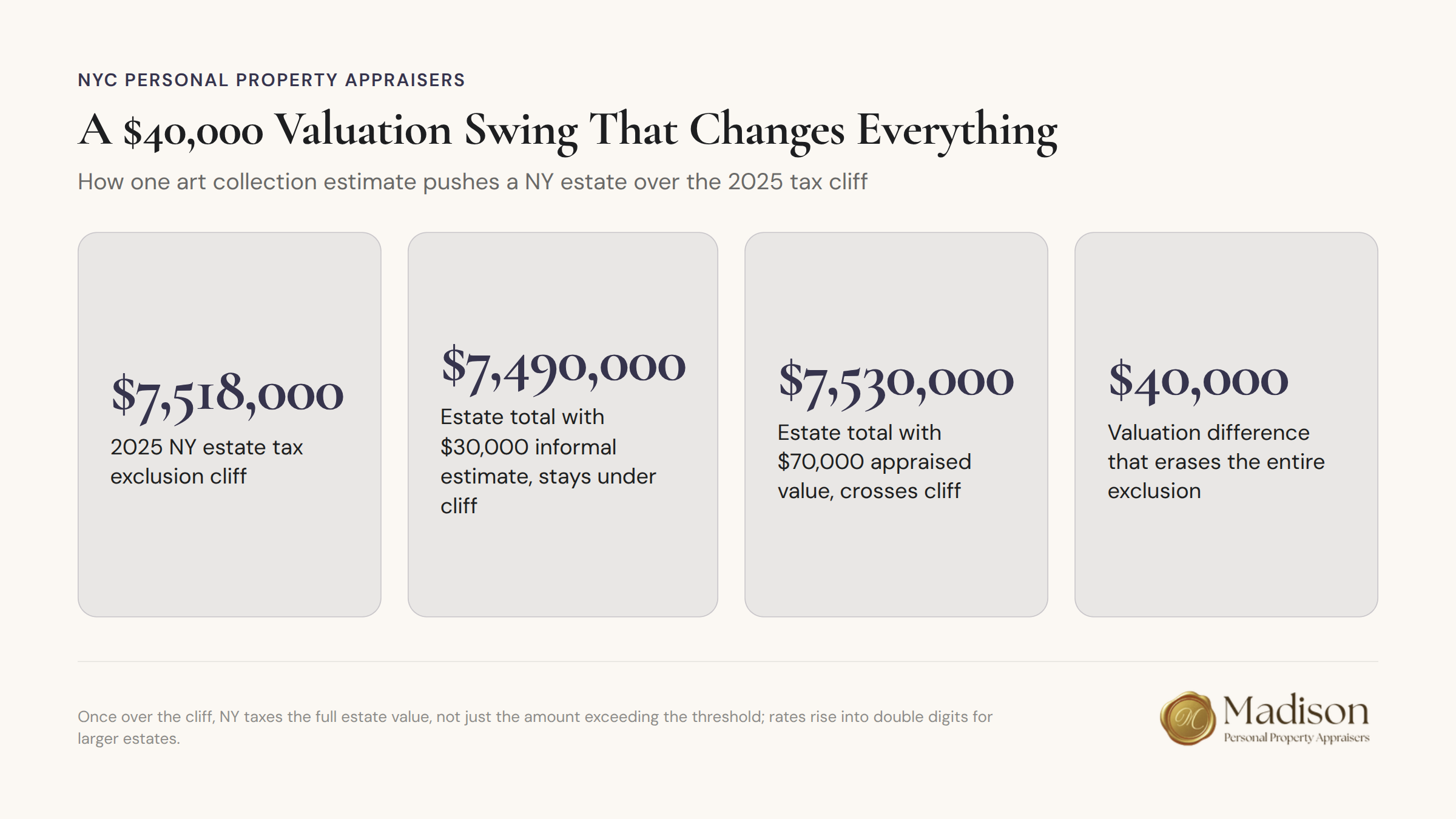
Under New York Tax Law and the Department of Taxation and Finance's estate tax guidance, the basic exclusion amount adjusts periodically. For deaths occurring in 2025, that exclusion is $7,160,000. The cliff threshold sits at 105% of that figure, or $7,518,000. An estate valued at $7,517,999 keeps its exclusion and likely owes little or nothing. An estate valued at $7,518,001 loses the exclusion entirely and New York taxes the full estate from the first dollar.
Analysts describing this structure have called it exactly that: a cliff, rather than a phase-out, because the drop in benefit happens over such a narrow band of estate values. The New York City Bar Association has characterized the range between 100% and 105% of the exclusion as an "extremely steep slope," and the language fits. A few thousand dollars of additional value, in the wrong place, can change an estate's tax outcome by hundreds of thousands of dollars.
Why Personal Property Valuations Matter Near the Cliff
Art, jewelry, antiques, and collectibles are usually the least precisely valued assets in an estate, and that imprecision becomes dangerous once the estate is near the cliff. Real estate typically gets a professional appraisal. Brokerage accounts report exact balances. Personal property, by contrast, is often estimated from memory, an old insurance schedule, or a family member's guess at what grandmother's jewelry or a modest painting collection might be worth.
That gap between an informal estimate and a defensible fair market value rarely matters for an estate sitting well below the exclusion or well above the 105% cliff. It matters enormously for an estate sitting in between. A $20,000 or $30,000 swing in the reported value of a personal property collection, the kind of swing that separates a casual guess from a documented appraisal, can be the entire difference between an estate that owes nothing and one that owes tax on everything it holds.
This is also where the cost of getting the valuation right deserves attention. Our breakdown of what determines personal property appraisal cost in NYC explains how fees are set by the scope of the assignment, not by the value of the items being appraised. For an estate near the cliff, a properly scoped appraisal is inexpensive insurance against a tax result that can swing by hundreds of thousands of dollars.
Worked Example: A $50,000 Art Collection at the Margin
Consider an estate with $7,460,000 in real property, brokerage accounts, and other financial assets, plus a personal art and antiques collection. The executor's informal estimate of that collection, based on old purchase receipts and a rough sense of current value, comes in at $30,000.
Add that estimate to the rest of the estate and the total is $7,490,000. That figure sits below the $7,518,000 cliff for 2025 deaths, so the estate keeps its exclusion and owes little or no New York estate tax.
Now suppose a qualified appraiser values the same collection at $70,000 instead of $30,000, a $40,000 difference driven by more accurate comparable sales research and correct attribution of a few pieces the executor had underestimated. The estate's total becomes $7,530,000, which is above the $7,518,000 cliff.
That single $40,000 difference in the personal property valuation moves the estate from full exclusion to no exclusion at all. New York calculates tax on the entire $7,530,000, not just the $12,000 that crossed the line. Depending on where the estate lands in New York's graduated rate table, which reaches into double digits for larger estates, that shift can move the estate's tax bill from zero to a liability well into six figures.
The example cuts both ways. An estate whose personal property is overstated by an informal guess can be pushed needlessly over the cliff. An estate whose personal property is understated risks a challenge from the state that retroactively pushes the estate over the same line, along with penalties and interest on top of the newly owed tax. Either error is expensive, and both are avoidable with a properly documented valuation completed before the estate tax return is filed.
New York's Cliff vs the Federal Estate Tax: A Side-by-Side Comparison
New York's cliff structure has no equivalent at the federal level, and confusing the two systems is one of the most common mistakes families make when estimating what an estate will owe. The federal estate tax, administered by the IRS, taxes only the amount of an estate that exceeds the federal exemption. New York taxes the entire estate once the value crosses 105% of its own exclusion.
| Feature | New York estate tax | Federal estate tax |
|---|---|---|
| What gets taxed once over the exemption | The entire taxable estate, from dollar one | Only the amount above the exemption |
| Mechanism | A 105% cliff eliminates the exclusion entirely | A straightforward marginal exemption, no cliff |
| Effect of a small valuation increase near the line | Can convert a $0 tax bill into tax on the full estate | Only increases tax on the marginal excess |
| 2025 threshold example | Exclusion $7,160,000; cliff at $7,518,000 | Exemption set separately under federal law, no equivalent cliff |
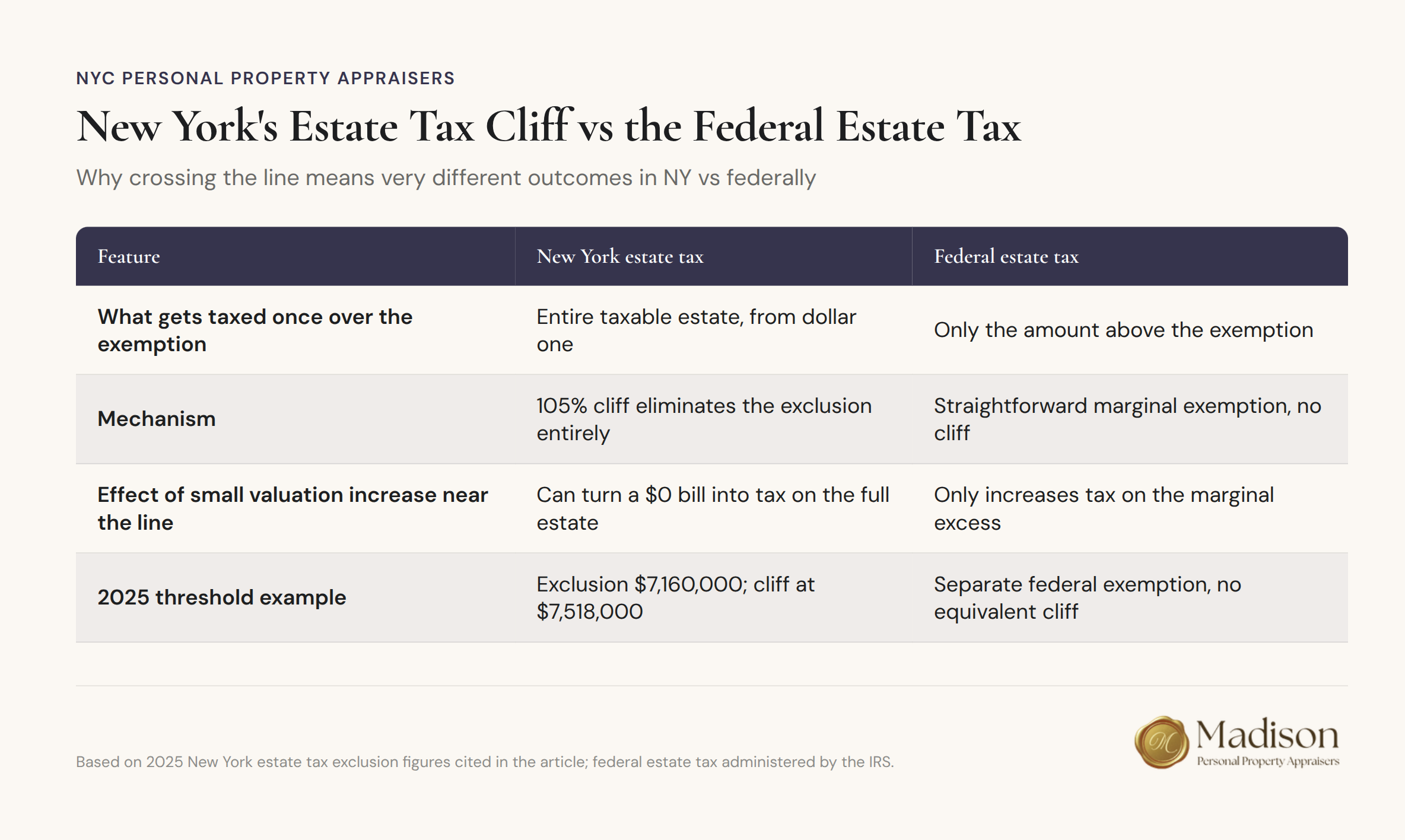
This distinction is exactly why New York estates with meaningful personal property need more valuation rigor than a comparable estate in a state without a cliff, or even a federal-only calculation. A family that assumes "we're only a little over, so we'll only owe a little" is applying federal logic to a New York problem, and the gap between those two outcomes can be substantial.
Why a Defensible Appraisal Protects Estates on Both Sides of the Line
A fair market value determination prepared in accordance with the Uniform Standards of Professional Appraisal Practice gives an estate something an informal estimate cannot: a documented, defensible basis for the number reported on the New York estate tax return. That matters whether the goal is confirming the estate sits safely under the exclusion or accurately reporting a value that happens to land above it.
Our appraisers hold credentials with organizations such as the American Society of Appraisers, the International Society of Appraisers, and the Appraisers Association of America, and every personal property appraisal we prepare is built for its intended use, including estate tax filings that face scrutiny from the New York Department of Taxation and Finance. An appraisal that only exists to support a low number invites exactly the kind of challenge that can retroactively push an estate over the cliff, with interest and penalties layered on top. An appraisal built on genuine market research protects the estate regardless of which side of the threshold it ultimately falls on.
Watch out: Insurance schedules and auction house estimates are not fair market value appraisals. They're built for different purposes (coverage limits and marketing forecasts, not tax defensibility) and executors who rely on them near the cliff are taking on risk they don't need to carry.
Getting the Number Right Before You File
The New York estate tax cliff turns personal property valuation from a formality into a genuine risk management question for any estate near the 2025 exclusion of $7,160,000. Because the cliff taxes the whole estate rather than just the excess, the cost of an imprecise valuation is not proportional to the size of the error; it can be the difference between owing nothing and owing tax on every asset the estate holds.
Engagements for estate tax valuations are quoted as a fixed fee after we scope the collection, never billed hourly, so executors know the cost before work begins. If your estate includes art, jewelry, antiques, or collectibles and the total value is anywhere near New York's exclusion threshold, request an appraisal before the estate tax return is filed rather than after a challenge forces the question.
This article is provided for general informational purposes only and does not constitute legal, tax, or financial advice. Readers should consult a qualified attorney or CPA regarding their specific circumstances.