
Blog
IRS Form 8283 and Qualified Appraisals: What NYC Art and Antiques Donors Must Attach
Donating art or antiques worth more than $5,000 triggers IRS Form 8283 and a qualified appraisal requirement, and deductions of $20,000 or more demand the full signed report attached to your return. This guide walks NYC donors through the dollar thresholds, the form's three signature sections, and the deadline that actually governs your appraisal.
A donor who gives a painting, a set of antique silver, or a piece of folk art to a New York museum or charity does not just need a receipt. Once the claimed deduction crosses certain dollar thresholds, the IRS requires a specific sequence of paperwork: a qualified appraisal, a completed Form 8283, and in some cases a copy of the appraisal itself attached to the return. Missing a step can mean losing the deduction entirely, not just shrinking it.
This matters more in New York City than almost anywhere else. The city's museums, auction houses, and estate collections mean donors here are disproportionately likely to be giving items that clear the $5,000 and $20,000 thresholds discussed below. If you're preparing an art or antiques donation appraisal for a New York institution, the mechanics of Form 8283 are worth understanding before you sign anything.
What Triggers Form 8283 in the First Place
Any taxpayer claiming a deduction for noncash charitable contributions totaling more than $500 in a tax year generally must attach Form 8283 to the federal return. That threshold alone doesn't require an appraisal; it just means the IRS wants the contribution documented.
The appraisal requirement arrives at a higher bar. Under the IRS Form 8283 instructions, a donor claiming a deduction of more than $5,000 for an item, or a group of similar items, must complete Section B and support the value with a qualified appraisal prepared by a qualified appraiser. Section A, by contrast, covers smaller donations and asks only for basic identifying information. Donors of art and antiques worth a few hundred dollars rarely need to think about any of this. Donors giving a $15,000 painting or a $40,000 collection of antique silver do.
The $5,000 Threshold: Where the Qualified Appraisal Requirement Begins
An appraisal becomes mandatory, not optional, the moment the claimed deduction for an item or a group of similar items passes $5,000. Below that line, a good-faith estimate or a dealer's letter might satisfy a tax preparer. Above it, the IRS wants a formal, signed document that meets the regulatory definition of a qualified appraisal, prepared by someone who meets the regulatory definition of a qualified appraiser.
Treasury Regulation 1.170A-17 spells out what that appraisal must contain: a detailed description of the property, its physical condition, the contribution date, the appraised fair market value, the valuation method used (sales comparison, cost, or income approach), and the specific evidence supporting that value. A one-page letter stating a dollar figure with no methodology does not meet this bar, no matter how respected the person signing it.
The $20,000 Rule for Art
Key takeaway: once a claimed art deduction reaches $20,000, the appraisal itself, not just the summary form, has to accompany the tax return.
For most donated property between $5,000 and $20,000, the donor keeps the qualified appraisal on file but does not need to send it to the IRS with the return. Art is treated differently. Once the claimed deduction for art is $20,000 or more, the donor must attach a complete copy of the signed appraisal to the return, not merely Form 8283. The IRS Art Appraisal Services, the unit that reviews these filings, also recommends attaching photographs of the donated pieces, even though photographs aren't strictly required below that threshold. Doing so reduces the odds that the valuation triggers an unnecessary audit inquiry.
Individual art objects valued at $20,000 or more carry one more wrinkle: the IRS can request a photograph of the specific item after the return is filed, so it's worth having one ready even if you don't attach it up front.
The $500,000 Threshold: When the Full Appraisal Becomes Mandatory, No Exceptions
A separate, much higher threshold applies regardless of asset category. When the claimed deduction for an item, or a group of similar items, exceeds $500,000, the donor must attach a signed copy of the qualified appraisal to the return, and this requirement generally cannot be satisfied with Form 8283 alone. Only narrow statutory exceptions apply at this level. For a donor giving a major single painting, a significant decorative arts collection, or a group of comparable antiques whose combined value clears half a million dollars, this isn't a recommendation; it's a filing requirement separate from, and in addition to, the $20,000 art rule.
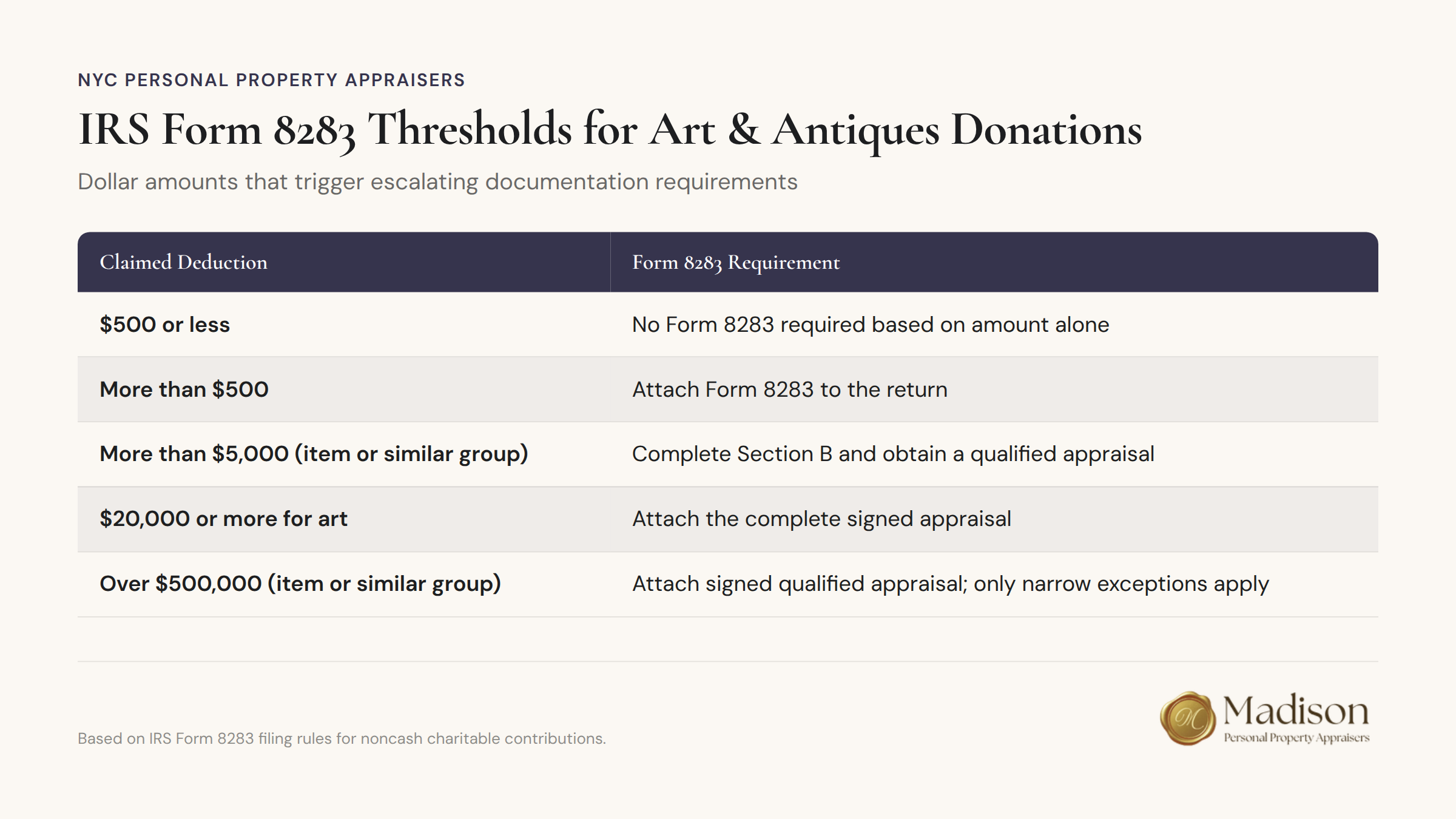
| Claimed deduction | What the IRS requires |
|---|---|
| $500 or less | No Form 8283 required based on amount alone |
| More than $500 | Attach Form 8283 to the return |
| More than $5,000 (item or similar group) | Complete Section B and obtain a qualified appraisal |
| $20,000 or more for art | Attach the complete signed appraisal |
| Over $500,000 (item or similar group) | Attach a signed copy of the qualified appraisal; exceptions are narrow |
Inside Form 8283 Section B: Three Parts, Three Different Signers
Section B of Form 8283 is where confusion tends to start, because it has three separate parts that get filled out by three different people, and it's easy to mix them up.
- Part III, the Taxpayer Statement, applies only to items the appraisal values at $500 or less. If every item in a group was individually valued at $500 or under by the appraiser, the donor can complete this part instead of requiring full appraiser sign-off on each line. This is not where the appraiser signs; it's a donor-completed exception for low-value items swept into a larger group.
- Part IV, the Declaration of Appraiser, is where the qualified appraiser signs. The appraiser attests to their qualifications, including background, education, and experience with the specific property type, and confirms the appraised fair market value stated on the form, per the IRS Form 8283 itself.
- Part V, the Donee Acknowledgment, is signed by the receiving museum or charity. The institution confirms it received the property and provides its identifying information. This signature does not mean the museum agrees with the appraised value; it simply documents that the gift was received.
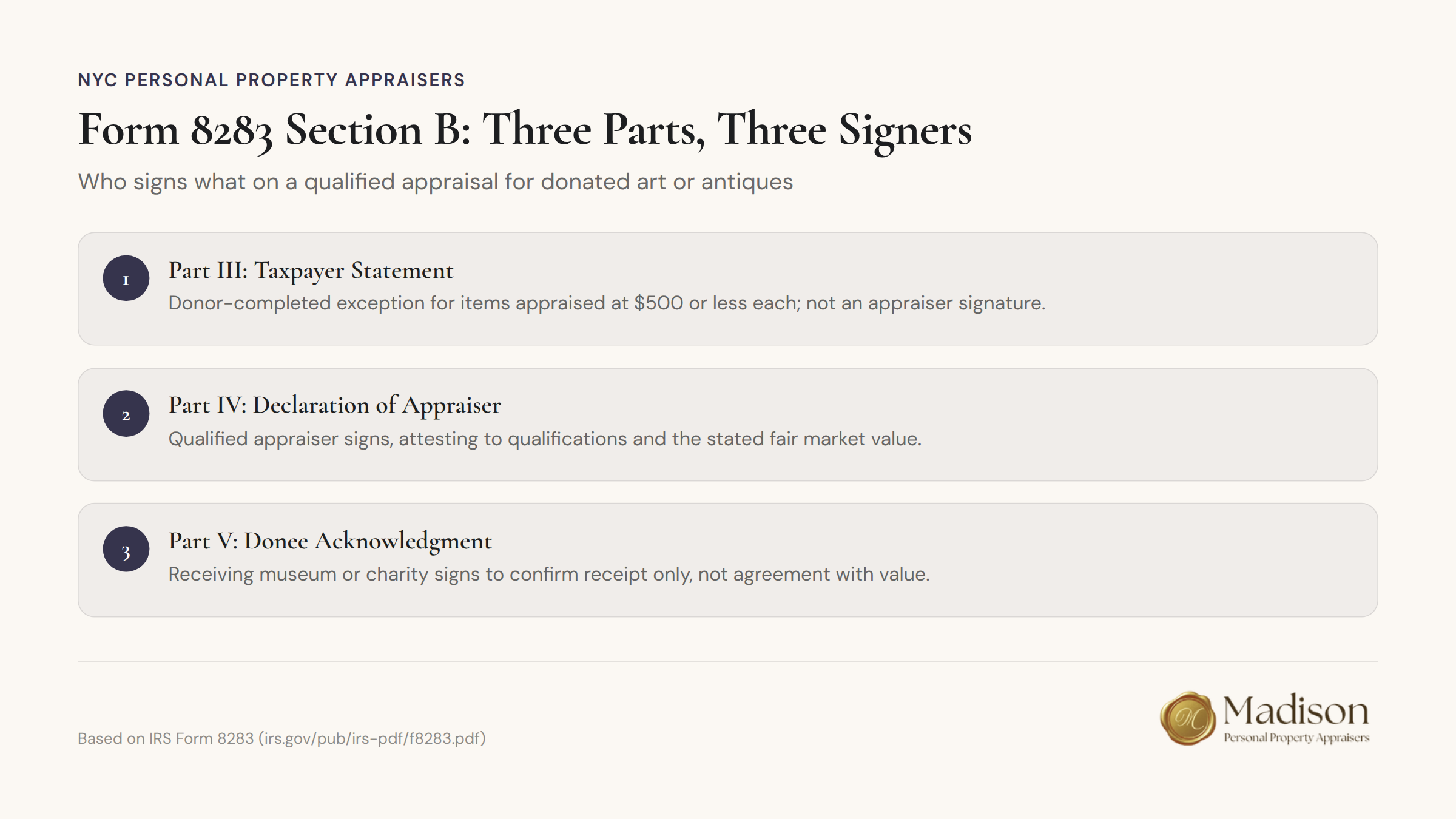
A donor who hands a museum curator the form to sign in Part V, assuming that also covers the appraiser's declaration in Part IV, will find the form rejected or the deduction questioned later. Each part needs the right signer.
Timing: The Appraisal Doesn't Need to Exist on Donation Day
One detail surprises a lot of first-time donors: the qualified appraisal does not need to be completed before or at the time of the gift. What matters is that the appraiser's signature falls within a defined window and that the donor has the completed appraisal in hand by the filing deadline.
Specifically, the IRS Form 8283 instructions require the appraisal to be signed and dated no earlier than 60 days before the contribution date, and the donor must receive the completed, qualified appraisal no later than the due date, including extensions, of the return on which the deduction is first claimed. If the deduction is instead first claimed on an amended return, the appraisal must be in hand before that amended return is filed.
Watch out: an appraisal is disqualified, not just late, if the donor withheld facts or misrepresented the property in a way a reasonable person would expect to cause the appraiser to misstate the value. Full disclosure to your appraiser protects the deduction as much as the paperwork does.
Why October 15 Turns Into a Rush Date for NYC Donors
Many individual donors file for the automatic six-month extension, which pushes the federal deadline to October 15. Because the qualified appraisal only needs to be in hand by that extended due date, a large share of art and antiques appraisal requests cluster in the weeks before it. Donors who gave a painting to a New York institution in March sometimes don't commission the appraisal until September, assuming (correctly) that the clock runs to the extended deadline rather than April.
That timing works, as long as the appraisal is actually completed, signed, and in the donor's hands before October 15. What doesn't work is waiting until October 10 to contact an appraiser for a complex antiques collection that needs research into comparable sales, condition assessment, and provenance documentation. Appraisals for donations with real market complexity, a significant single artwork, a mixed collection of antique furniture and silver, a group of decorative arts pieces, take real time to prepare properly.
Choosing a Qualified Appraiser for Art and Antiques
The regulatory definition of a qualified appraiser requires verifiable education and experience valuing the specific type of property involved, and independence from the donor, the donee, and the transaction itself. General appraisal experience in an unrelated category doesn't satisfy this; an appraiser who regularly values machinery isn't automatically qualified to value 19th-century American paintings.
Our appraisers hold credentials with organizations including the American Society of Appraisers, the International Society of Appraisers, and the Appraisers Association of America, and every report is prepared in accordance with the Uniform Standards of Professional Appraisal Practice set by The Appraisal Foundation. For donors who need an IRS-qualified report rather than a standard valuation, our personal property appraisal services are quoted as a fixed fee once we've scoped the assignment. For artwork, that typically starts from $395 for an IRS-qualified report; for antique furniture, silver, and similar antiques, IRS-qualified appraisals typically start from $295. Fees are driven by the complexity of the collection, the research required to document comparable sales, and the number of items involved, not by the item's market value itself. Every engagement is quoted and agreed before work begins; nothing is billed by the hour.
Getting the Paperwork Right the First Time
The thresholds in Form 8283 are unforgiving. A donor who skips Section B on a $7,000 sculpture, or forgets to attach the signed appraisal on a $25,000 painting, risks having the entire deduction disallowed rather than just the excess over the limit. The fix is straightforward: know which threshold your gift falls into, confirm which Part of Section B needs which signature, and start the appraisal with enough lead time that October 15 is a formality rather than a deadline sprint.
If you're planning a donation to a New York museum or charitable organization and need a report built to meet these requirements, our team can scope the assignment and provide a quote for a qualified appraisal before any work begins.
This article is provided for general informational purposes only and does not constitute legal, tax, or financial advice. Readers should consult a qualified attorney or CPA regarding their specific circumstances.