
Blog
Personal Property Valuation in a New York Divorce: Equitable Distribution and Valuation Dates Explained
Personal property valuation in a New York divorce depends on two questions: is the item marital, and as of what date is it valued? This guide explains equitable distribution, how the court picks valuation dates, and how an appraisal supports a fair split of jewelry, art, watches, and household contents.
In a New York divorce, personal property valuation comes down to 2 questions: whether an item is marital or separate, and which date the court uses to put a number on it. Get either one wrong and a watch collection, a painting, or a jewelry box can swing the settlement by thousands of dollars. This guide walks through equitable distribution, the valuation-date rules, and how a professional appraisal from our personal property appraisers gives both sides, and the court, a defensible figure to work from.
Key takeaway: New York is an equitable-distribution state. Marital personal property is divided fairly, not automatically 50/50, and the value used depends on a valuation date the court selects somewhere between the start of the case and trial.
Is New York a Community Property State?
No. New York is an equitable-distribution state, not a community-property state. In community-property states, marital assets are generally treated as owned half and half. In New York, the court divides marital property in a way it finds fair after weighing the circumstances of the marriage.
"Equitable" does not mean "equal." Under DRL § 236(B)(5), the court considers factors such as the length of the marriage, each spouse's income and property, age and health, earning capacity, contributions as a spouse and homemaker, tax consequences, and any wasteful dissipation of assets. A court may award an item to one spouse and offset its value with a payment or other asset, or order a sale and divide the proceeds.
What Counts as Marital Property and What Stays Separate?
Marital property is anything either or both spouses acquired during the marriage and before a separation agreement or the start of the divorce action, no matter whose name is on the title. Here is the language of DRL § 236(B)(1)(c):
"The term 'marital property' shall mean all property acquired by either or both spouses during the marriage and before the execution of a separation agreement or the commencement of a matrimonial action, regardless of the form in which title is held..." - DRL § 236(B)(1)(c)
Separate property is defined in the same statute and generally includes the following:
- Property acquired before the marriage
- Property received by bequest, devise, descent, or gift from someone other than the spouse
- Property acquired in exchange for, or with the proceeds of, other separate property
- Property the spouses designated as separate in a valid written agreement
The line can blur. Separate property can become marital through commingling or transmutation, for example when an inherited necklace is sold and the proceeds go into a joint account that buys a new piece. If you want a primer on the categories themselves, our explainer on the two types of personal property covers tangible and intangible items.
Watch out: Possession is not ownership. The spouse who keeps a piece of jewelry at home has not thereby made it separate property, and the spouse whose name is on a receipt has not made it solely theirs.
How New York Courts Choose Valuation Dates
The court sets the valuation date, and it can set different dates for different assets. DRL § 236(B)(4)(b) lets the court choose a date or dates anywhere from the commencement of the action to the date of trial. The choice is discretionary.
There is a useful guidepost that courts commonly apply, described in the New York Courts decision-after-trial materials and in appellate cases such as Bean v. Bean:
- Active assets are assets whose value is driven by a spouse's ongoing effort, such as a business. Courts often value these near commencement, so one spouse's post-filing work does not inflate the other's share.
- Passive assets are assets whose value moves with the market or inflation, independent of either spouse. Courts often value these as close to trial as practicable, so the split reflects what the asset is actually worth when it is divided.
This is a guide, not a rule. Courts keep flexibility, and the facts of each asset matter.
One more timing point: the Court of Appeals held in Mesholam v. Mesholam that where an earlier divorce action ended without a divorce, the earliest valuation date is the commencement of the later action that produced the divorce. Your attorney should confirm which action is the operative one.
Pro tip: Classification and valuation are separate questions. Classification asks whether an item is marital or separate. Valuation sets the number for what is marital. Do not mix the dates up.
Applying Valuation Dates to Jewelry, Art, Watches, and Household Contents
Most tangible personal property behaves like a passive asset. Its value changes because the market changes (gold prices, auction results for a particular artist, demand for a watch reference), not because either spouse is working on it. That makes the gap between commencement and trial a real financial issue, particularly in a case that runs a year or more.
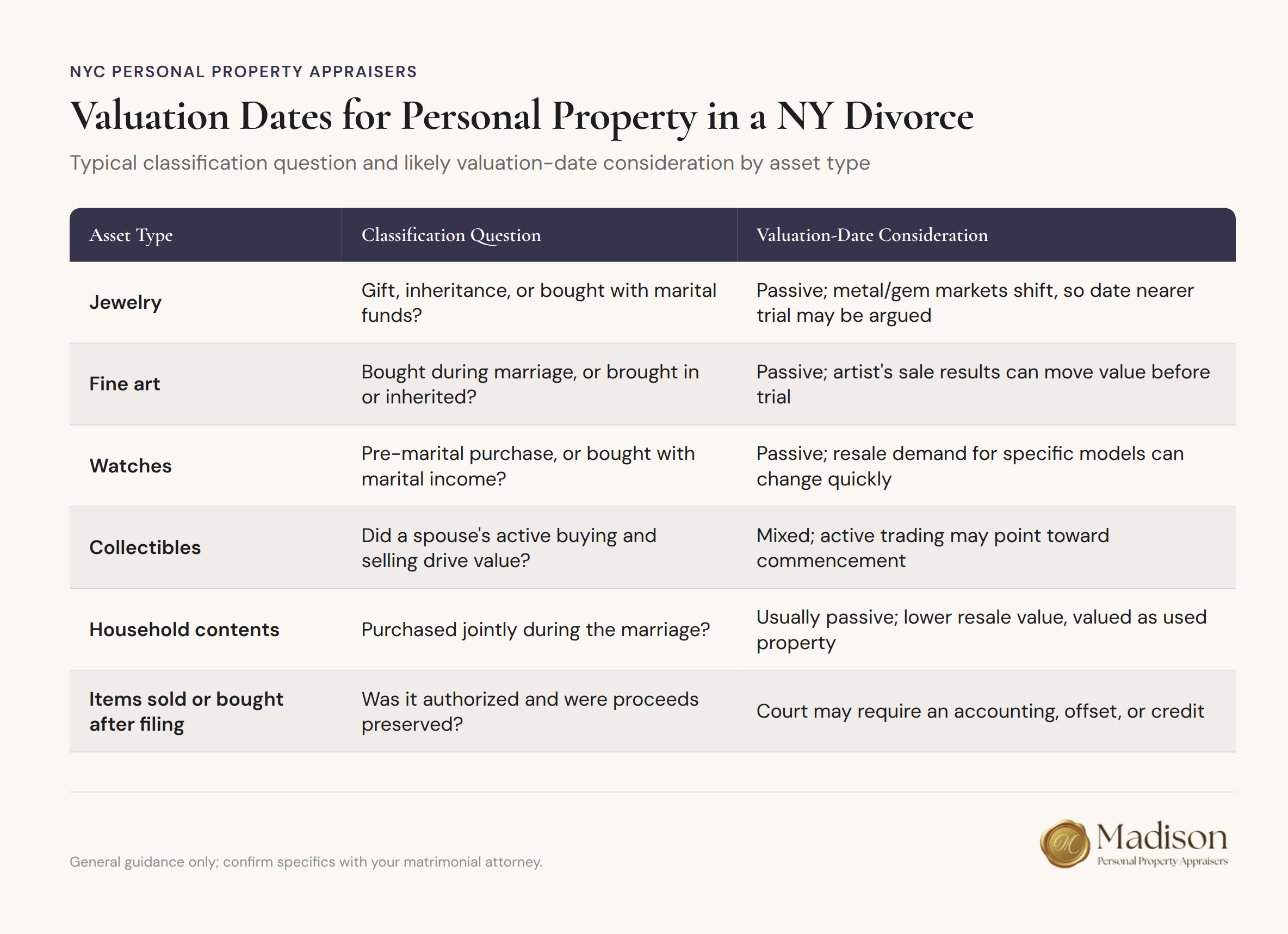
The table below shows the typical classification question and valuation-date consideration for common categories. It is general guidance only; confirm the specifics with your matrimonial attorney.
| Asset Type | Typical Classification Question | Likely Valuation-Date Consideration |
|---|---|---|
| Jewelry | Gift from spouse, inheritance, or purchased with marital funds? | Passive; metal and gem markets can shift, so a date nearer trial may be argued |
| Fine art | Bought during the marriage, or brought in or inherited? | Passive; sale results for the artist can move value between filing and trial |
| Watches | Pre-marital purchase, or bought with marital income? | Passive; resale demand for specific models can change quickly |
| Collectibles | Did a spouse's active buying and selling drive value? | Mixed; active trading may point toward commencement |
| Household contents | Purchased jointly during the marriage? | Usually passive and lower resale value than retail cost; valued as used property |
| Items sold or bought after filing | Was the transaction authorized and were proceeds preserved? | Court may require an accounting, offset, or credit |
Our appraisers value each item as of the effective date your attorney or the court specifies, so the same inventory can be valued as of commencement, trial, or both if the lawyers need to compare.
Example: A couple owns a painting and a 3-piece watch collection bought during the marriage. The action commences on March 1, when we value the group at $48,000. Trial happens 20 months later, and the same items are worth $56,000 on the market. If the court uses the trial date and divides the group equally, each spouse's share is $28,000 instead of $24,000, a $4,000 difference per spouse driven purely by market movement. That is why the valuation date is worth settling before the appraisal begins.
Why a Professional Appraisal Supports a Fair Split
In a divorce, two parties with opposing interests scrutinize every number, so the valuation needs to hold up if challenged. A professional appraisal replaces guesses, retail receipts, and insurance replacement figures with a documented opinion of value prepared in accordance with USPAP (the Uniform Standards of Professional Appraisal Practice, published by The Appraisal Foundation). We do not claim a particular court will accept any report; the court decides that. What we can do is prepare a report with a clear methodology, defined type of value, and an effective date.
The type of value matters. Depending on the jurisdiction and the instructions, equitable distribution can call for:
- Fair market value: what a willing buyer and willing seller would agree on, both with reasonable knowledge of the facts
- Net value: value after accounting for costs such as selling expenses or liens
- Value in use: the worth of the item to its owner, reflecting what it would cost to substitute for the portion being divided away
Because definitions vary, our appraisers take written direction from the client or the attorney on the type of value and the effective date before work begins. We do not decide what is marital or separate. The law and the court do. Our job is to value the items you and counsel identify.
Our appraisers hold credentials with leading organizations such as the ISA, ASA, and AAA, which are the main credentialing bodies for personal property. The right appraiser for jewelry, art, or furnishings depends on the items in your inventory.
Preparing Your Inventory and Documents Before the Appraisal
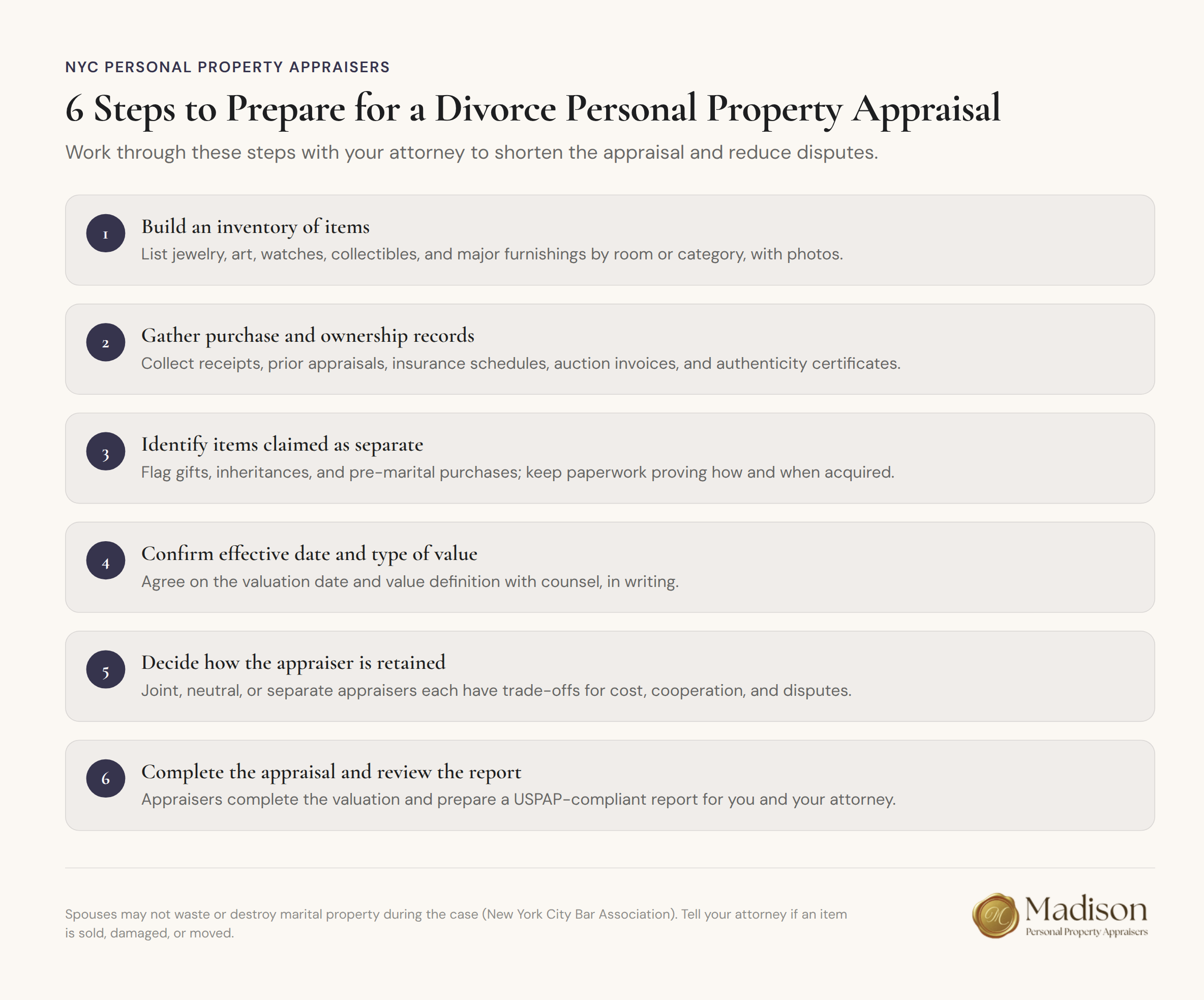
A well-organized inventory shortens the appraisal and reduces disputes. Work through the following steps with your attorney:
- Build an Inventory of Items
- List jewelry, art, watches, collectibles, and significant household furnishings by room or category, with photographs.
- Gather Purchase and Ownership Records
- Collect receipts, prior appraisals, insurance schedules, auction invoices, and certificates of authenticity.
- Identify Items Claimed as Separate
- Flag gifts, inheritances, and pre-marital purchases, and keep the paperwork that proves how and when they were acquired.
- Confirm the Effective Date and Type of Value
- Agree on the valuation date and value definition with counsel, in writing.
- Decide How the Appraisal Will Be Retained
- Parties sometimes retain a joint or neutral appraiser, and sometimes each side retains its own. Each approach has trade-offs for cost, cooperation, and how a disagreement is resolved, so discuss it with your attorney.
- Complete the Appraisal and Review the Report
- Our appraisers complete the valuation and prepare the USPAP-compliant report for you and your attorney.
For most households, we perform the appraisal online from photographs and documentation. On-site inspection is available for larger engagements, such as a full residence with extensive art or antiques.
Watch out: A spouse may not waste, destroy, or reduce the value of marital property while the case is pending, according to the New York City Bar Association. If an item is sold, damaged, or moved after commencement, tell your attorney immediately and keep records of what happened to it and the proceeds.
What Does a Divorce Personal Property Appraisal Cost?
Every engagement is quoted as a fixed fee before work begins, and we never bill hourly. Our published fees for personal property appraisals start at $195 for standard reporting, with typical engagements running $395 to $2,200 and the highest-complexity assignments running $1,600 to $3,500+. A whole-household divorce engagement with many items is scoped first, then quoted as a single fixed fee.
The fee is driven by scope, not by what the items are worth:
- The number of items and categories to be valued
- The complexity of the items (a fine art collection takes more research than standard furnishings)
- The quality and completeness of your records
- The intended use and the depth of analysis required
A more valuable piece does not cost more to appraise just because it is worth more. For the full picture, see how the New York fee ranges work in practice.
Settle the Date and the Documents First
The fairest split starts with the right questions answered early: which items are marital, which valuation date applies, and what type of value the court expects. Confirm those with your matrimonial attorney, assemble your records, and have the appraisal prepared as of the effective date counsel specifies. If you are ready to put numbers on the jewelry, art, watches, and household contents in your case, request an appraisal and we will scope it and quote a fixed fee.
This article is provided for general informational purposes only and does not constitute legal, tax, or financial advice. Readers should consult a qualified attorney or CPA regarding their specific circumstances, including the classification of property and the selection of valuation dates in their case.